by Tom Larkin
One of the first groupwork and personal development techniques I learned, while working with a youth organisation almost 50 years, ago was a French method of self-expression and group process called “Photolangage”. It became a tried and trusted method that I employed effectively over the years in a variety of formal and non-formal educational situations with children, young people and adults. When we invite images in Focusing, they usually come from the body and we usually ‘see’ them in our mind and sometimes express them with art materials on paper – an inside-out approach. However, we can also work from the outside-in like in Photolangage.
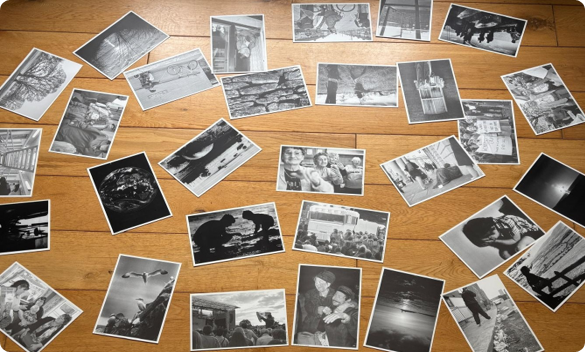
Basically, Photolangage, as an in-person exercise, involves laying out a set of 17cm X 25 cm black and white photographs, usually on the floor, or a big table, about four photos per person in the group. The participants are given a prompt e.g. “Allow a photo to present itself to you which best answers the question – ‘Who am I?’ or ‘What does community mean for me?’ or ‘What is really important in my life right now?’ etc.” They are then asked to slowly walk around the room viewing the photos, as they might paintings in a gallery, until one photo seems to jump out at them and ‘answers’ the particular question posed for them.
I have always been amazed at how doing this seems, for a lot of participants, to bypass the thinking or judging part of the brain and, more often than not, participants are surprised by what emerges for them. Readers who are familiar with Focusing will be familiar with this kind of experience. For this reason, I believe that Photolangage works perfectly with Focusing. In the same way as when we read a poem and the poem as a whole, or perhaps a verse or just a line resonates with something inside and there is a ‘shift’, the image/photo does something similar at a symbolic level. Maybe words will come after, or not but in the moment, something in the image has represented the person’s inner experience and it is felt in the body as a change in some way. Some of you reading this may remember workshops I did with the then Irish Focusing Professionals Support Group in 2018 or with the IFN in 2022.
Of course, finding (and paying for) sets of photographs can be difficult nowadays. In that case you can curate your own sets of photos/images from postcards, Tarot, Oracle or other game decks (that don’t have names or words printed on them), photo or card sets from online retailers, images from books or magazines which can be laminated for multiple uses.
What I have described above applies to working with groups and the method can also be used individually. It is important to formulate a question (a wondering, a curiosity) first e.g. How am I about this decision I have to make? Then lay out the cards/photos/images on a table, asking yourself your question and allowing an image (or two) to stand out from the rest. If the image does not feel like the ‘right’ one you can always look for another or allow an image to emerge from your body. This method might be particularly useful for Focusing on one’s own or as an alternative when a Felt Sense is not easily forthcoming.
by Fiona O'Meara
So many people ask me:
‘How can I use Focusing during the day?’
Whilst nothing can replace a longer Focusing session, turning towards ourselves during the day can lead to profound change — especially when done gently and skillfully.
P.A.L. is an acronym used by Ann Weiser Cornell that helps us attune to ourselves quickly and simply.
It stands for Pause, Acknowledge and Listen.
I find it useful for three reasons:
- Easy to remember.
- Easy to follow.
- Easy to notice when I’ve skipped a step (it contains the key elements of inner attending).
Here it is:
Pause:
Simply take a moment to pause and sense into your body. You might take a breath, feel your feet on the floor, and bring awareness to your body.
Acknowledge:
Notice what is going on inside. Feelings, thoughts, sensations, or a vague sense of something may come into awareness. Then gently turn towards what is there and simply say:
'Yes, I know you’re here.’
Ann often phrases this as:
‘I’m sensing something in me that feels this way, and I’m saying hello to that.’
You might also place a gentle hand on that area.
Listen:
Just listen to what is here, and how this place feels from its own perspective. There is no pressure for deep insight or immediate change. We are simply taking the time to listen.
This helps build inner trust and self-compassion. And if something does let you know how it feels, it can help to gently let it know:
‘I hear you.’
So give P.A.L a try and remember:
We are not doing this exercise in order to feel immediate relief.
We are simply giving attention to something that is asking for our attention.
We pause because something in us matters.
We acknowledge what is here with honesty.
And we listen with company rather than judgement.
Over time, this quiet way of relating to ourselves can help build greater calm, trust, compassion and resilience.
Offered by John Keane
Affection Teacher Exercise:
Those of you who are familiar with Focusing will have heard of the Focusing Attitude. It is the inner environment we create to safely welcome our important feelings, emotions, and physical sensations.
BioSpirituality offers a subtly different approach we call our Affection Teacher. Our Affection Teacher is a way of being present to our inner experience by recalling times in our life where we felt safe, accepted, and loved. Allowing that experience to teach us or guide us in how to be physically present to our inner experience.
The following exercise is one of my favourite ways of exploring our innate capacity for gentle presence. It can help develop your own Focusing Attitude or Affection Teacher. It is something I have used over the years and may have its foundation in other Focusing exercises. Therefore, I do not take any credit for creating something new.
Affection in Nature:
Begin by allowing your mind to quieten a little by bringing your attention to your breath or your physical body – shifting your attention away from the usual issues you normally think about. Pause…
After a little time, allow your attention to drop down inside your body – that place between your throat and your abdomen – that place where the language of your body is felt most deeply.
Perhaps you can spend some time noticing what it feels like to come home to yourself in this way – allowing distractions from your mind to ease away, just noticing the body feel of this kind of internal presence. Pause…
Now I invite you to imagine that you are taking a walk in the forest.
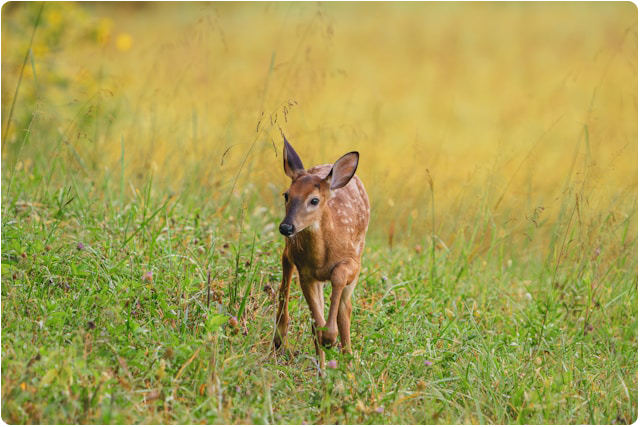
The usual sounds of the forest are interrupted by an unusual noise. Your pace slows and you begin to scan your surroundings – you realise that the noise is one of distress. Then you see a movement up ahead. As you draw closer, you see a baby deer, it is wounded, struggling and in pain.
You pause as you do not want to startle this vulnerable creature by rushing towards it. The baby deer sees you and retreats a little – it is not sure if it can trust you.
Perhaps you can notice what feels right inside as you see this vulnerable creature in the distance. Do you remain still, or do you rush towards it? What can you do to make sure the baby deer does not feel more scared – what can you do to allow the baby deer to feel that it can trust you a little bit?
Notice how the pace and timing of your movements impacts upon the relationship between you and the baby deer. Allow yourself to notice the subtle dance of becoming aware of what makes the baby deer feel safe and what scares it – this interaction guides you more than any intention to control.
When the time is right – when the baby deer feels safe enough to allow you to be close to it. Notice how you can hold it in a way that allows it to feel even safer. Nothing you can say will matter in this interaction. Rather, it is the tone of your voice, the gentleness of your touch that will enable the baby deer to feel safe and not alone anymore.
This relationship of trust and safety can grow and mature from this place. You are now in a place where you can care for this wounded baby deer.
Now, can you imagine being with your own important feelings in this way. Not needing to rush to control – but willing to be gently present until the trust that is needed has emerged in its own time.