Using Focusing in Everyday Life by Marian Burke
When I signed up for this workshop, facilitated by Mary Jennings. I didn’t really give any thought as to what it might be about. I guess the title appealed to me. Some people said it was exactly what they were looking for. Certainly, it is a skill we can all use and the more we practice, the better we get at it.
Rather than detail all the language Mary used, I will attempt to write what I took away and hope I got it right! Mary referenced a piece from Tom Larkin’s Ma Thesis: Making space for the more, Focusing as Embodied Spiritual Practice. “Focusing needs to become a person’s natural “go to” response to life’s conundrums, not just discreet sessions alone with a Focusing partner, beneficial as they may be.”
Mary explained the difference between a Focusing partnership and everyday Focusing. In a partnership you may say something like; “Maybe you would like to take all that inside you” or “can you sense the whole of that?”
Listening to friend or neighbour you wouldn’t dream of saying anything like that. But you could say “That’s a lot for you to carry” or “you have a lot on your plate” (My words) Or “I’m sorry this is happening to you; I am happy to listen if it would help.”
Mary explained the need for us to notice when someone is struggling for a word to explain how they are feeling and to allow the space for them to find the right word or say what they are trying to say.
She also spoke about how helpful this can be in a meeting, if someone wants to share and is struggling with the language to use. I shared how this often happened to me, but I was often shot down by an unhelpful chair person or someone in the group.
Mary was suggesting listening in a Focusing way. For instance, pausing and clearing a space.
Coming from a place of curiosity and care. Checking our felt sense before we speak.
Let their words come into a Focusing space.
Pay attention to tone of voice, pacing, are we rushing? Let it flow naturally. Use reflective listening as appropriate. Notice their hesitations, use of metaphors, feeling word etc. It’s ok to experiment. If we feel it’s not resonating with the other person, pull back. It’s ok to get it wrong, they can correct us.
To sum up.
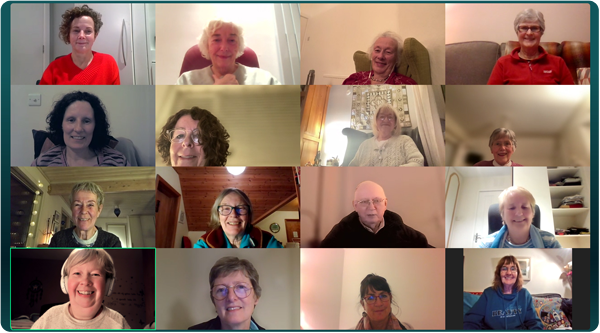
“Listening and responding in a Focusing way is not just for Focusing Partnerships ̶ it’s for life! You might like to try some of these ‘steps,’ and other ideas offered tentatively here in everyday conversation when it seems right. You can experiment yourself with your own sense of what would be appropriate. By being in touch with your own felt-sense and bringing curiosity and care to your interactions, you might find your conversations become a lot more interesting! We got a chance to practice all this in break out rooms.
In the workshop we also looked at having our needs met, asking for what we would like, without it sounding like a command or an order. Again, emphasis on tone etc.
Mary gave some examples like “would you be willing to? Would it work if you … How would it be for you?” My own favourites are: “I have a favour to ask, I know you’re busy, but… or softening the request with any chance…?! I might get “ What is it this time?” But it always works!
We also looked at saying “No” without feeling guilty. Some examples: “I’d like to say yes, but…..; I know this is important to you, but I’m not in a position to help right now, maybe we could explore options that might work. Or just be clear and direct and say I’m really sorry, but I can’t help.
I remember being at a workshop once, where it was said, we don’t have to give any explanations why we can’t do something. I am in a choir and sometimes we get big long stories as to why they can’t attend. I have taken on board the advice from the workshop and I just say; “I’m sorry, but I’m not available next Wednesday!” However, if it is family or close friends, I would usually tell them why.
We also got a chance to practice in pairs some Interactive Focusing, based on the work of Janet Klein. We listened to the story, then created what she called “An empathic moment.” This involves checking with the Focuser, if it is ok to share how their process touched us. This allows for more empathy and for the Focuser to go more deeply. They may choose not to reply, or correct us if we got it wrong.
Mary wanted to do more work about using metaphors and Thinking at the Edge, but she felt it would be rushed. She used some lovely poems by Seamus Heaney to illustrate her point. Mary was conscious she was rushing it, so it was suggested another workshop would be appropriate.
Since doing the workshop, it has refreshed my awareness for practicing better listening. I have also found it exciting catching myself when I listen accurately and reflect back appropriately. Recently listening to a friend telling me about when herself and her husband got clamped. It would have been very easy (maybe usually) for me to tell her my experience of being clamped. But I remembered our workshop and allowed her to stay with her frustration and I will do this more often.