Gathering Together in Dublin - Sept 2025
Focusing is usually a very quiet and personal affair. Even when partnered with another, increasingly our ‘bodies’ are not in the same room, as most partnerships occur via Zoom.
Our bi-annual in-person gatherings, therefore, are a real treat - a chance to meet face-to-face, reconnect, catch up on all things Focusing (and life); laugh together, lunch together, and partner in person. It was lovely to see some new faces there.
This September, we were gifted two excellent workshops, hosted respectively by John Keane and Mary Jennings, each offering rich group discussion, partnering, and individual work.
John Keane’s workshop, “Process Skipping,” was full of insight into how we often ‘skip’ over what most needs our attention. We do this every day, usually without noticing it: scrolling, making more tea, peeking in the fridge (food is my big distraction!) - all ways of avoiding an unwanted feeling inside ourselves. It’s an easy habit, especially in a culture that favours us always feeling ‘something better.’
I loved how John reminded us that we don’t need to drop these habits overnight or dive into a long inner process each time. Simply pausing to check inside before reaching for the familiar distraction can, over time, be quietly transformational. John shared a phrase from Fr. Ed McMahon (co-founder of BioSpiritual Focusing): “What in my body right now most needs my caring, loving presence?” A beautiful practice to carry into daily life.
Our second workshop, led by Mary, offered an inspiring introduction to the Olive Tree project - an initiative supporting community leaders working with Arabic-speaking refugees in Iceland to rediscover some inner safety. The programme grew from earlier work with community leaders in Palestine.
Blending Focusing with psychological first aid, mindfulness, and insights from neuroscience, the project offers a powerful, adaptable framework for anyone supporting people healing from trauma. We tried several of the exercises ourselves and felt their impact. (If you’d like to read more about the Olive Tree project and its origins, you can do so by clicking here)
As ever, meeting in person strengthened both our practice and our connections. We look forward to carrying what we learned into our everyday lives - and to gathering again in the spring. If you haven’t yet been, we would love to welcome you.
by Fiona O'Meara
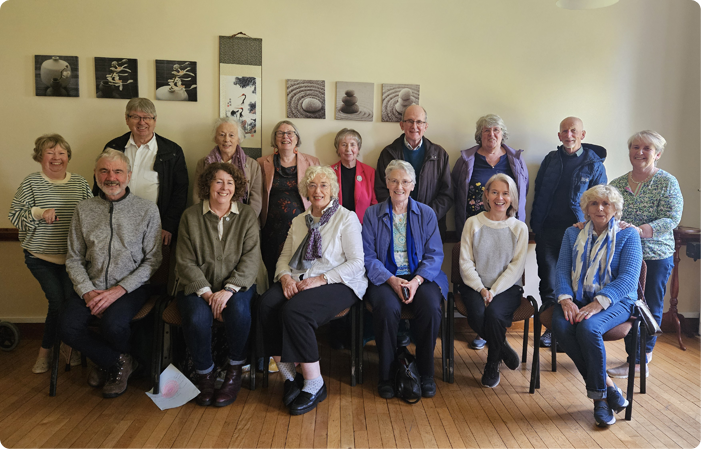
Irish Focusing Network Members
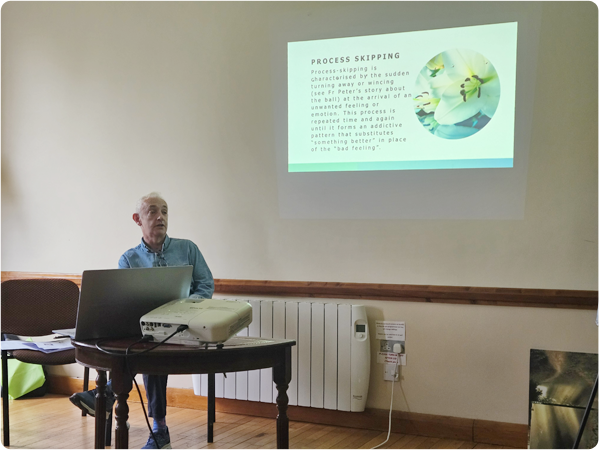
John Keane
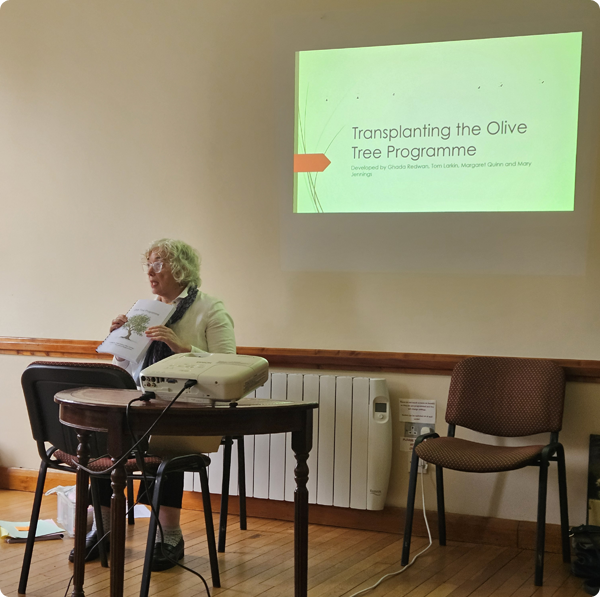
Mary Jennings
Where Life Says “Welcome”: A Weeklong Experience
by Marta Fabregat
When you enter a Focusing community, something unmistakable meets you. It is not dramatic or announced, but an atmosphere shaped by people who have spent years learning to listen, deeply, quietly, and with care. The moment you arrive, you feel yourself arriving into that. It is as if you step into a living tapestry, woven from many threads of welcoming, of contact that is intact and gentle, and of the subtle possibility that something new might emerge. This ambiance is not about being positive or idealising the experience, nor about presenting Focusing as something mystical or exclusive. As I write, I am careful not to create the impression of a perfect or sectarian world. Growth and richness do appear in these gatherings, yes, but just as present are the life processes that are struggling, stretching, or seeking relief. Both belong.
In this experience, there is also something that, for many people, marks a clear before and after: the home group. These small daily circles act as a kind of temporary household within the Weeklong, a place where Gendlin’s philosophy becomes quietly embodied. There, without effort or pretension, one understands, through the body, that inner life has its own way of moving forward, its own signature, its own gentle drift that grows in companionship. In the home group, each person sits alongside others who do not interfere or direct, but accompany with a steady, supportive presence. This closeness allows us to recognise that existing authentically in the company of others is both simple and profoundly human. One’s own inner drift begins to take shape, and at the same time feels held by the calm presence of those around.
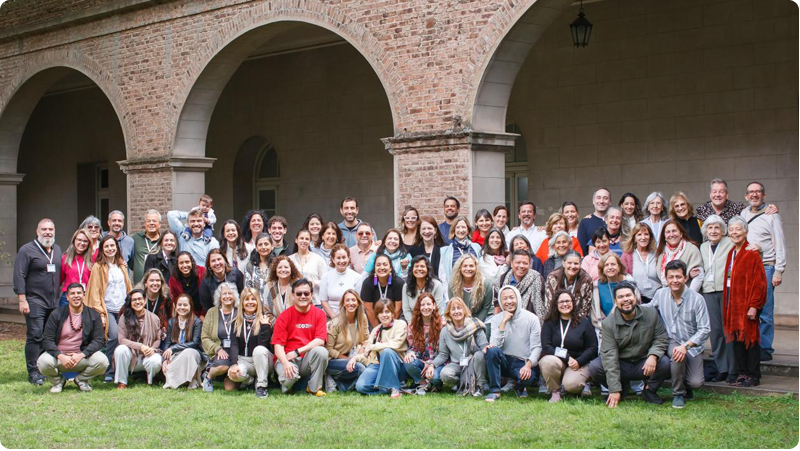
During the International Focusing Weeklong in Buenos Aires, what became evident was how the environment and the people were inseparable. The conditions that support living movement were available to us, and we, each in our way, were part of creating those very conditions. A community does not float above its participants; it emerges from them. Each person interacts with their own inner life, and with one another, in ways that make room for movement, for unfolding, and for a livelier sense of being. This is what stayed with me: a sense that the community continues long after the gathering ends, through the threads of contact that keep living in and through us.
It is difficult to speak of the magnitude of being part of such a Week, long enough for our pieces to find one another, meeting themselves in our company and in the company of others. Something happens in that span of days. At first it might feel mysterious, but perhaps it isn’t mystery in the dramatic sense. Perhaps it is simply life sensing us sensing it, a mutual awareness that gradually becomes visible. This sensing does not stay fixed or solidify into a repeated loop. Instead, it keeps shifting, responding, and opening. There is room in it for movement, for change, for something more to come. And in that gentle back-and-forth between our inner places, the presence of others, and the wider field, we sometimes feel life itself saying, almost with a smile: hey, welcome.
So yes, this is my poetic rant about a truly special gathering. The Weeklong took place from the 3rd to the 9th of October at Centro Loyola in San Miguel, Buenos Aires province, Argentina. This edition was fully in-person and carried the vibrant rhythm of simultaneous English, Spanish, and Portuguese translation flowing quietly underneath everything. It was designed for advanced Focusing practitioners, those certified by TIFI or well on their way, and included, as always, the annual certification ceremony. This moment was especially lively and joyful this year. Being in Latin America adds something unmistakable: the flavors of its culture, the rhythm of dance, and the music that seems to live deep in the bones. For someone coming from Europe, it offers a generous invitation to let the body move and to feel its own vitality in new ways.
Many nights unfolded into music, storytelling, and a very special last evening with a spontaneous folly performance that left us laughing and amazed. One could have wondered whether the performers had been rehearsing all year, yet it was entirely born in the moment. It arose from the simple delight of being together, acknowledging the joy of contact, and allowing playfulness to set the stage for us. Participants came from all across Latin America, with a small group from Europe and a few more from the United States, Canada and China.
I feel a deep bow of gratitude to the coordination team: Ceci Burgos, Joseph Sing, and René Veugelers, who accompanied the whole process with such care, artistry, and quiet dedication. And alongside them, Catherine Torpey was a constant, supportive presence who helped make this Weeklong unforgettable.
A big bow to all of them, and to all the community in Argentina for hosting us with such care and dedication, and to all who were there participating.
Human beings with human beings. Nothing more, nothing less. And somehow, that is everything.
When you enter a Focusing Weeklong,
All belong.
IFN Committee Update Dec 2025
It’s hard to believe we are drawing near to the close of another year. I’m sure that this newsletter will brighten even the darkest day. Many thanks to Elaine and her team for the valuable work they do.
Our gratitude goes to those who facilitate our Refresher evenings which continue from January on the last zoom session of the month. A reminder that our associate members are very welcome to join these evenings and our online workshops too. We are also very grateful to our weekly Zoom hosts who help to provide the space for Focusing each week, we couldn't do this without you.
We would love to see you in these spaces. If you are a Focusing teacher and would like to lead a Refresher evening, we still have one or two slots to fill before the summer. Please get in touch.
Please save the date! Our AGM will take place on Tuesday, 27th January and we would love you to come. This is your chance to share what is important for you about the IFN, what you might like to see happen in 2026 and how you might be willing to help, even in some small way.
On behalf of the IFN committee I wish you gentleness and peace at this time of year.
We look forward to your continued presence and support in 2026.
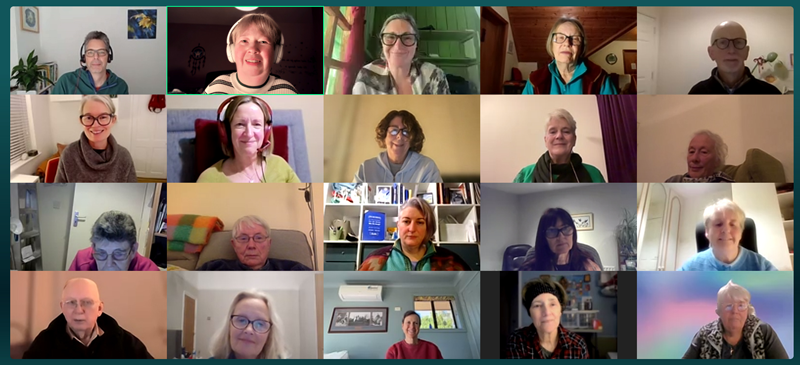
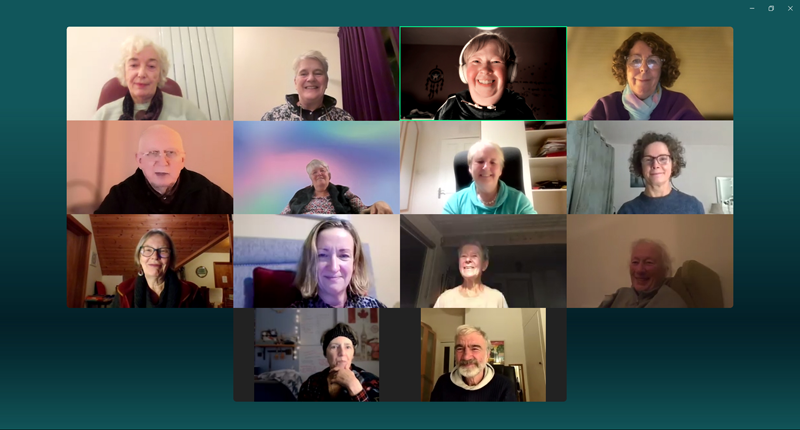 Refresher Evening - November 2025
Welcoming Grief Workshop with Peter Gill
The IFN were delighted to host an online evening with Peter Gill recently. Peter is a Focusing Coordinator and trainer based in the UK. He is also a qualified Somatic Experiencing Practitioner and Nature connection Facilitator.
Peter’s workshop was titled “Welcoming Grief”. This is a theme he has explored through Focusing for many years. Peter began the workshop by reading the poem 'When Death Comes' by Mary Oliver and invited us to notice our body’s response to the words.
In breakout rooms we discussed our relationship with grief. It was powerful to hear our commonalities and differences. Peter described how indigenous communities honour the grieving process through ritual. In our society, we seem less able to welcome and allow space for grief.
Peter described grief as a living process which needs to be contained and released. The analogy of water needing a channel in order to flow resonated with me. Focusing, in offering a space where the body brings what needs to be heard, offers a container for grief. The gentle presence of another can help us acknowledge loss and release our grief. Nature too can be a container for grief.
Peter referred to a book by Francis Weller called 'The Wild Edge of Sorrow'. Weller describes different kinds of grief which he names “the five gates of grief”. I found this a powerful way to move beyond my familiar and narrow concept of grief towards a more interconnected experience of loss.
After exploring the theme of grief together as a group, we had a welcome opportunity to Focus in a partnership on our personal experience of grief. It felt like this workshop touched tender places for many of us. I found the image of the container reassuring - Focusing offers me a safe space to be with loss and helps me welcome grief as a natural and important part of my living process.
by Therese Ryan
Wild Edge of Sorrow - Francis Weller’s book :
https://www.francisweller.net/the-wild-edge-of-sorrow-the-sacred-work-of-grief.html
Love and Loss: How Focusing Helped Me Grieve My Father
On 10th June, 2024 my father died.
I’d like to share how Focusing helped me process the pain of losing him. It feels especially relevant now, after Peter Gill’s ‘Welcoming Grief’ workshop for the IFN in November.
I sat with him every day in the week leading up to his death. A farmer all his life, I’d been used to him being tall, strong and father-like. Now, after months of hospitalisation, he was like a little bird in the bed, alive, but tiny and helpless. Skin sagged from his stick-like limbs, his body was lost amongst the pillows and his mouth gasped loudly for breath. He couldn’t speak, and looked consumed by pain, although the nurses said he was comfortable.
He was eighty-one and had severe dementia for years. Dying would be a release for him, I knew that. But as I sat beside him, my own pain kicked up fiercely inside me. I’d never been on this earth without him, and any hour now he would be gone.
Never again would I feel his arms around me, welcoming me home, or hear him laugh at my banalities when I called him for a chat. He had been a sensitive, kind man, who liked to love and be loved. Now, I felt like I had not fully appreciated his regard for me, but had come to expect it like some kind of movie star. I was filled with remorse.
A part of me wanted to flee the enormity of the loss that was coming. David Whyte in his essay Solace asks - “...how will you bear the inevitable that is coming to you? And how will you endure it through the years?”
I did not know how I would endure it. In my pre-Focusing life, I had done what most people do when pain feels unbearable - I unconsciously cordoned it off inside, and tried to think positively. But I'd seen how those painful places only became sealed-off, frozen in a point in time, forever calling to be experienced.
This time, at least, I knew it was better to feel the pain - if I could.
We were so lucky to have a private room, in a quiet part of the hospital. My mother sat with him for nearly ten hours a day for over three months. He very rarely became irritable with us, even though he was in grueling pain due to a spinal fracture and had no understanding of what was happening. He was forever trying to climb out of bed and get back to the farmyard. It had been a full-time job trying to stop his escape.
But now he had got an infection and wasn't responding to the antibiotics. It was clear he hadn't long. A terrible swirling sensation began inside me, and it felt that - if I weren’t careful - at any moment I could become engulfed by it.
Something habitual in me began to try to avoid, deny, reassure… (I saw now how often I had sought refuge in what John Keane calls ‘process skipping’). But thanks to all the years of Focusing, I was able somehow to step into the centre and feel it, now, before it all got sealed away.
I wept a lot in the weeks leading up to Dad’s death. It was a relief to be able to cry so freely - I could not do that in my pre-Focusing years. I regretted all the moments I had rejected him - the times I had perceived him as ‘weak’, or inconsistent, or too keen to please. How I wished I could have appreciated him a little more, just as he was, instead of thinking he should be a little different. As I cried by his bedside, he no longer knew day from night. But he wiped the tears from my face with a blanket from his bed.
After it was all over, and Dad was finally free of his suffering, I did not experience the exhaustion that seems to be the norm after a funeral. Instead, I felt more alive. Alive to who he really was, and to my family and to myself as we are now. I think something happened as I sat with him, something special, that left me changed.
by Fiona O'Meara
Creative Corner: Ice Bells
“Do you see what I see?”
Stepping out in December means finding a branch near the river’s edge where water has dripped along the branch and has frozen in the form of small bells.
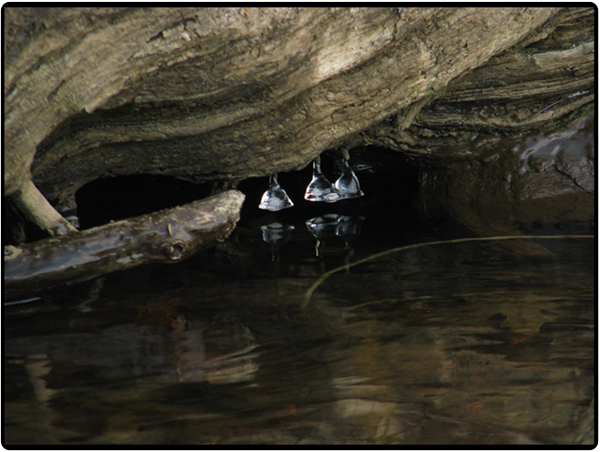
"Ice Bells" by Denise Durocher
On the banks of Le Lièvre River, Québec December 2024
Listen to the river ripples as they break along the branch, and
.. “Do you hear what I hear?”
the ice bells are ringing a soft melody for you at Solstice and Christmas time...
The more I think about this Christmas song …
It starts with: “Said the night wind to
the little lamb”…
And the questions follow:
“Do you see what I see?”
“Do you hear what I hear?”
“Do you know what I know?”
As I live alone, I realize that to better see, hear and know, I need to head outside. Especially in December when my reflex is to hibernate, I still must leave my cave of indwelling and go meet wind, snow, river, trees, people, birds, stars, moon, family, friends, music, etc.
My Focusing partners have helped me “see, hear, know” whenever I move into the ZOOM space and go to meet them. So often, I have no idea what will happen during our session, but when I step out of my “cave” and go towards the ZOOM meeting space, I know I will find some surprise waiting for me.
For me, to better see, hear and know, I need relationship: to nature, to individuals, to community and in particular, the IFN community.
Does this ring true for you too?
by Denise Durocher December 2025
Creative Corner: The Scroll
by Denise Durocher
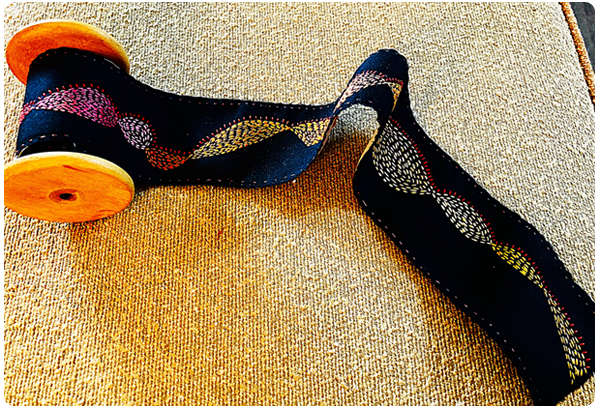
The Scroll by Denise Durocher - Old bobbin, black fabric, white backing, embroidery floss.
I started this fabric scroll which is four inches wide and about 2 meters long. My only parameters are using gradients of embroidery floss colours and a wave design. It is a slow process since I’m making so many stitches, and it kind of feels like a useless project. But I read something the other day: "This is worth doing for no other reason than that it is nice to do. So do it." (Can’t find the author, sorry).
It's a bit like my Focusing Sessions since for both, I don't know exactly how they will end. What will be revealed to me? Focusing has a method, I also gave this piece some structure: colours, waves. But will I like it once I'm done? I don't know. But as I stitch, something is revealed to me in the simple fact that I’m showing up to do it. As sometimes we don’t know why we decide to participate in a Focusing Session on a particular day. We just show up and most often than not, are amazed by what is revealed to us during that time.
Maybe some of you who read this will notice that in your own life, you are also working on something that hasn't fully revealed itself yet. I think that the fact that you are showing up, investing the time, the effort and the love, is in itself a revelation worth considering.
Video of what the scroll looks like so far!
Tribute to Father Peter Campbell 1935 - 2025
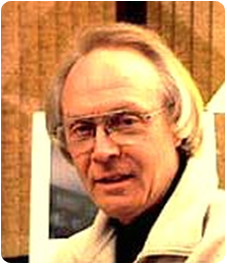
Fr. Peter Campbell
On July 5, 2025, the Focusing community lost one of its brightest lights with the passing of Father Peter Campbell. For more than fifty years, Father Peter devoted his life to teaching and living Focusing from a deeply Biospiritual perspective. His vision and dedication were instrumental in spreading Focusing worldwide, particularly throughout the 1980s and 1990s, as he and Father Edwin McMahon led countless domestic and international BioSpiritual education programs. Their efforts profoundly shaped the understanding of Focusing, highlighting its transformative potential for individuals and communities alike.
Father Peter was not only an educator but also a prolific author. Along with Father Edwin McMahon he co-authored many articles and books—BioSpirituality: Focusing As a Way to Grow, Beyond The Myth of Dominance: An Alternative to a Violent Society, and Rediscovering the Lost Body Connection in Christian Spirituality—that continue to inspire, heal, and guide readers across the world. The Nada Lou collection of his BioSpiritual videos further showcases his depth of insight, authenticity, and willingness to share his own vulnerabilities for the benefit of others.
Even in later years, when travel became impossible, Father Peter embraced technology, using a website (biospiritual.org), Skype and Zoom to continue sharing his wisdom. His commitment also led to the co-founding of the BioSpiritual Institute, ensuring that the BioSpiritual legacy would endure and flourish for years to come.
Above all, Father Peter embodied what he taught. Those fortunate enough to meet him in person experienced his genuine compassion and kindness. His ministry was dedicated to making “mysticism for the millions” a reality, empowering countless individuals to connect with their Inner Divine Wisdom and experience what Gene Gendlin called the “grace” of the felt shift.
The Focusing community will continue to benefit from the inspirational light of his presence, now lived out in all those who caught the fire from him and continue to practice and share Focusing. His light will also guide and uplift us, reminding us of the profound impact that one life, lived with faith, purpose and love, can have on the world.
Thanks to Joe Colletti for sharing this with us
Focusing and the Enneagram
by Therese Ryan
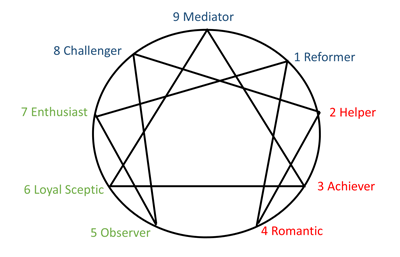
The Enneagram is a powerful psychological and spiritual system which helps us recognise our ingrained patterns of thinking, feeling and behaving. Decades ago, when the Enneagram began to be widely taught, type patterns were something to be gotten rid of. Now, in the Enneagram world, it’s all about understanding, appreciating and befriending our type patterns. And this is where I get very excited about how the Enneagram and Focusing compliment each other and invite us into a deeper relationship with ourselves.
Discovering my Enneagram type was the beginning of an ongoing exploration of the mainly unconscious survival strategies that helped form my personality. I lead with type six patterns. There are certain themes that resonate for everyone who lives with these patterns – doubt and anxiety among many others. And yet my lived experience of my “sixness” is unique to me, to my inner world.
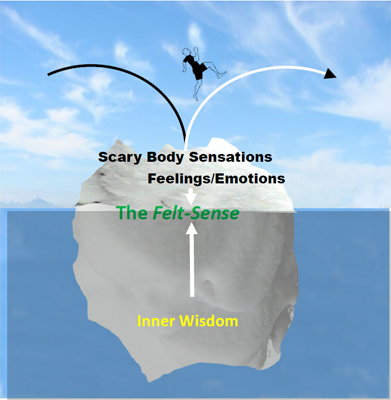
Sometimes it seems that there’s nothing new for me to know about doubt. Focusers, however, understand that what our body has to say about who we are and how we are is often a surprise. When I take this word, doubt, freshly inside, Focusing makes it possible for me to peer into doubt’s dusty corners, to teeter at its edge and to discover something in me that’s strong and assured, an inner platform of support. In this way, the felt sense of a familiar theme is a doorway to who I am beyond my patterns.
We encounter our Enneagram patterns in all areas of our lives and of course they show up too when we Focus, perhaps in our anxiety about doing it “right”, or the gush of overwhelming emotions, or the difficulty in sensing into the body at all, or the push to get somewhere. Understanding my Enneagram patterns has helped me recognise and understand what gets in the way of me being present, not just when I Focus but in life.
The Enneagram unflinchingly points out our blind spots too. My suspicion for example, has been difficult to honestly acknowledge and yet Focusing enables me to attend kindly to whatever I discover within myself. My patterns often feel fixed and limiting, a block to my living process and yet through Focusing I’ve come to trust that that they too hold an implicit intricacy which offers freedom.
Both the Enneagram and Focusing see each person as a living process, always changing, longing to live life forward. Focusing with the Enneagram has enhanced my experience of both. Together they offer a way to navigate life. The Enneagram is a map showing us where we are, how we get stuck and pointing us in the direction of growth. Focusing is the compass that helps us find our way.
Process Skipping Online Workshop Reflection
By John Keane
In April and May this year, I offered an online workshop on the subject of Process Skipping. The group (40 people) met each week for 4 weeks for 2 ½ hours each week.
In my years of teaching BioSpirituality, I have come to appreciate the importance of this process to healthy human development. And, I have come to the sense that it is a process that needs time, space and gentleness to fully engage with it.
This program examined Process Skipping, a process identified by Eugene Gendlin and further developed by Frs. Peter Campbell and Edwin McMahon. Process Skipping is characterised by an unconscious avoidance of uncomfortable feelings or emotions. As such it can be a barrier to being lovingly present to what may need our attention. By understanding and addressing Process Skipping behaviours, individuals can find freedom from control and domination, engaging more authentically with reality.
Program Structure:
- Personal Exploration: Participants are invited to identify their own Process Skipping behaviours.
- Cultural Context: Examination of how cultural structures influence Process Skipping.
- Alternative Perspectives: Investigating love and its embodiment as alternatives to control and dominance.
The essence of this process is that it is now a maladaptive stress response. Its initial purpose was to prevent or minimize some perceived conscious or unconscious pain. This process becomes habitual over time.
Process Skipping can operate on a number of levels which we explored during the program.
- Mental or Rational Process Skipping
- Activity or behaviour Process Skipping
- Emotional Process Skipping
- Physical Process Skipping
At the beginning some of the participants expressed their reluctance about exploring this well defended aspect of our living. I acknowledge that it requires courage to engage with this program. BioSpirituality is not about doing therapy (although many therapeutic benefits can be gifted to us in this process). So, it is important to stress to participants, that if they discover process skipping mechanisms that may be harmful to themselves or others – they should seek the appropriate therapeutic help and guidance.
As the workshops progressed the support of the group was important as participants became aware of their process skipping patterns. There was the realisation that we all do this – and many shared that it also gave them an understanding and an empathy for friends and family that have their own expressions of process skipping.
There was a sense of wonderment in the group about how clever we were to protect ourselves initially when we encountered danger or stress. But also, a sense of relief, that we don’t need to do that anymore. Those parts of ourselves that were lost can become our greatest teachers and treasures.
It was also clear that the group developed a sensitivity and appreciation about the relationship between process skipping and addiction. Pete and Ed always stressed that some element of process skipping is evident in most cases of addiction. We are no longer powerless about this when we become aware of this process that is initially unconscious.
It was also clear that this program did not provide enough time for people to explore as deeply as they desired. This was the first time I have offered this workshop, next time I will provide more time. Time for refection between sessions, and more sessions to engage with the intricacies it reveals.
In essence, awareness and exploration of process skipping in both personal and cultural terms is a call to live into and develop a sensitivity for love and gentleness. It is akin to a kind of conversion experience, when we discover that we no longer need to control and manipulate our feelings. Living into these feelings and experiences can set us free. We begin to live life as it is – and not how we might wish it were. There is freedom beyond control…
Children and Focusing Intro Day Experience
by Ann Harte Barry
Last June I attended my first IRL (in real life) focusing event since Covid. And what a wonderful re-entry it was!! I was really happy to meet old friends, to meet Zoom companions and to meet focusers I had not met before - and to feel that all 17 of us are all on the journey together.
The Children and Focusing Introduction Day, led by René Veugelers and Elaine Goggin, was held in the Dominican Retreat Centre, Tallaght – a very suitable venue in terms of welcome, comfort and accessibility.
The advertising blurb stressed that the training was not only for professionals working with children but ‘also supports and deepen your own process’.
That was so true! I personally found that while there was some stress on children all the exercises and teaching everything spoke directly to the various levels of child in me! It was immensely helpful. We were told that ‘you can’t move faster than your slowest process’. This is such a helpful starting point as often I am impatient, wanting ‘results’ and forgetting that other piece of wisdom shared: ‘the answer is already unfolding underneath’.
 The day was very helpful in helping me remain with the process and allowing what needed to emerge to emerge! The resources were creative and well designed and really helped my process. Of course the highlight was the use of emoji balls which ticked so many boxes!!
During the course of the presentation I did become very clear how focusing can be a powerful positive energy in working and being formally and informally with children.
René’s powerful sharing on his work with a young person demonstrated the power of living focusing attitude, creative process suggestions and staying close to the felt sense, all done in a dynamic sensitive and fragile setting. We were blessed to receive this sharing and deep within I believe that in some mysterious way that we were compassionately present to the young person’s life and who knows how the power of that energy has rippled out from our group supporting his search for fulness of life.
The Invitation: to consider training for focusing with children. It was clear that the day was a ‘taster’. Certainly I am very convinced of the potential of focusing with children and can see that the training would be stimulating, deepening and enjoyable.
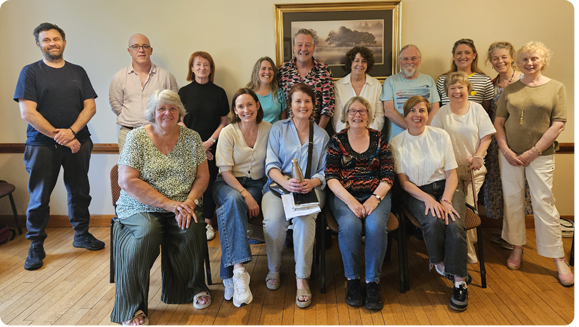
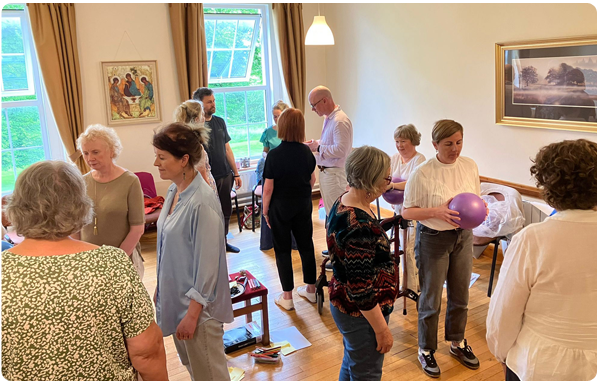
Group attending Children and Focusing Introduction Day in Dublin - 28th June 2025
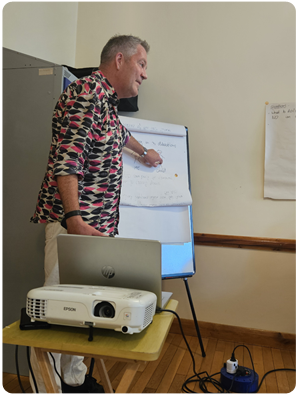
Facilitator Renè and Elaine
Planting an Olive Tree in Iceland!
by Margaret Quinn
Where to begin……
The story of how we found ourselves leading a training course for people who would facilitate a programme designed to promote resilience among refugees and asylum seekers in Iceland begins in another place and another time.
 In 2011, Mary Jennings and Gerry Conway were invited to travel to Gaza to work with the Palestine Trauma Centre (PTC). The initiative was sponsored by the Quaker Community in Galway and the UK and had the aim of teaching basic Focusing skills to the personnel of PTC. In 2013, they returned to Gaza, this time accompanied by Rene Veugelers, to explore ways of using Focusing with children. The team then created a twelve session programme for community groups which would be offered by PTC. Delivery of that programme was led by Ghada Radwan, who translated the programme into Arabic and worked to ensure that it was culturally appropriate and included multi-modal approaches – using art and drama for example.
Over time, Ghada developed an interest in deepening her Focusing practice and becoming a Focusing Trainer herself. Her great desire was to share Focusing with others in Gaza, particularly those who could bring Focusing to their work as psychologists, teachers etc. Ultimately, she hoped to train Focusing trainers in Gaza. Mary undertook to support Ghada through her initial training process and became her primary mentor. It was during this time that Ghada connected with the newly emerging Irish Focusing Network. Some of you will have met her during online courses she joined during the pandemic.
Having completed her Focusing training, Ghada invited Mary, Tom Larkin and myself to support her in preparing a training programme to expand her work in Gaza. When we had completed the first part of this work, Ghada began to work with a group of psychologists. It was interesting to hear that they found the Focusing approach fresh and different. Many wanted to continue their training. We were beginning work on the second phase of that project when war broke out.
There are so many ways that work can be disrupted, or projects derailed – illness, relocation, personal circumstances. What actually happened was beyond anything we could have imagined. Not only did the work stop, but, for long stretches of time we lost contact with Ghada and were left wondering if we would ever hear from her again. We worried for Ghada and her family, we felt helpless to offer support other than the messages we sent. Destruction of the communication infrastructure in Gaza meant that very often those messages were met with silence. We would wait, sometimes for weeks, for any response which would let us know that they were still alive.
As the months passed and we watched the horror unfold, Ghada and her family were displaced several times, two of her nieces died when a bomb targeted a house close to where they were sheltering, food and water became more difficult to find and communication remained sporadic. Finally, Ghada, Mohammed, Eilia and Elite were displaced to a tent in Rafah.
Our Focusing project was stymied, so Ghada turned her attention to the other needs she saw around her. It came as no surprise to us to discover, in occasional messages, that she was supporting mothers in Rafah to access food and supplies for their babies. Accessing support from “Challenge to Change” she was able to help 50 families to keep their babies fed and clothed despite the awful circumstances. Above all, her energy was focused on keeping her daughters well and encouraging them to retain hope of a better future. She has told us that drawing on Focusing during this ordeal was a great support. As the assault on Rafah began, however, Ghada and Mohammed decided that, to protect their children, they had no option but to leave Gaza. The story of how this was achieved would take a novel and strain belief. Suffice it to say that the efforts of many friends and the brilliant co-ordination of efforts by Sigríður Þorgeirsdóttir, who works at the university of Iceland, and Donata Schoeller, who many of you know from her courses with the Focusing Institute, resulted in the family leaving Gaza on the day before the Rafah crossing closed for good – making departure impossible.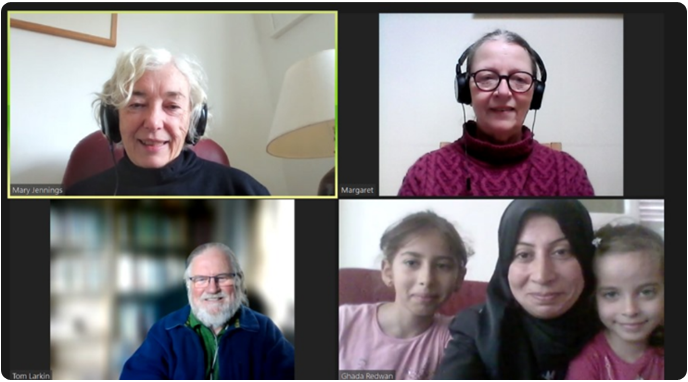
In Cairo, Ghada once again had access to the internet and I can still remember what it felt like to see her on Zoom during that first meeting. I remembered the story Ghada told us about the woman in Gaza who said “I am not waiting for death, I am seeking life.” This resilient little family despite having to leave behind home and family, sought to live meaningfully in this no-ones-land that was their time in Cairo.
This was when our shared project entered a new phase. Never one to waste time, or stint energy, Ghada wanted to offer some support to displaced Palestinians in Egypt. Our thinking was that we could best support them by creating a programme designed to reclaim or re-build resilience. The Olive Tree project was born.
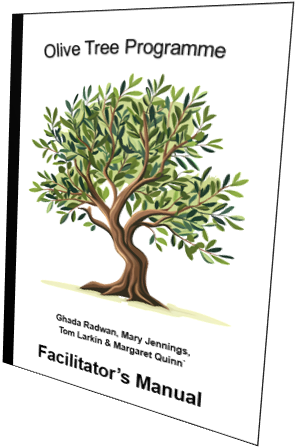
While it was difficult for Mary, Tom and me to imagine how this could be organised, Ghada was already in touch with groups like “Challenge to Change” (a Swiss charity) and exploring ways to offer the programme to online to Palestinians in Egypt, Lebanon and Jordan. She’s not a woman to let the grass grow under her feet. We went back to our planning meetings and hammered out an approach which blended Focusing with Psychological first aid models, mindfulness practices and insights from neuroscientific research.
While it was difficult for Mary, Tom and me to imagine how this could be organised, Ghada was already in touch with groups like “Challenge to Change” (a Swiss charity) and exploring ways to offer the programme to online to Palestinians in Egypt, Lebanon and Jordan. She’s not a woman to let the grass grow under her feet. We went back to our planning meetings and hammered out an approach which blended Focusing with Psychological first aid models, mindfulness practices and insights from neuroscientific research.
As the work continued, it became clear that remaining in Egypt long term might not be possible and, thankfully, Ghada’s friends in Iceland again came to the rescue, supporting her application to study at the University of Iceland.
So what now for the Olive Tree Programme? Online offerings were a possibility, but how to do it? The programme was coming together and we believed it would be useful, but, as Gendlin might put it: “What’s possible now?”
We reckoned without the creativity and “go-for-it-ness” of Ghada, Sigríður and Donata as well as the generosity of the Icelandic government and “Challenge to Change”. An application for funding was successful and before we knew it, Ghada was asking us if we could be available to travel to Iceland to train a group of facilitators to deliver the Olive Tree Programme to Arabic speaking refugees and asylum seekers there! Who could say no?
In late May, as we took our seats on the plane, Mary turned to me and observed – in a tone of complete astonishment – “We’re going to Iceland!” There had been so many obstacles and challenges along the way. What had started out as “notes for Ghada” had to become a manual which would be accessible to people who knew little or nothing about Focusing – it took months! This new iteration of the programme also involved adding a layer of facilitator training – another manual for us - no small task in itself. Then there was the organisational end – travel arrangements, venue and the rest – all brilliantly handled by Una Þorláksdóttir. The decision to proceed was not without its worries either. We were setting out to offer training to a group we had never met, about whom we knew very little except that several of them worked with Arabic speakers through the Red Cross or Municipal authorities in Iceland. A small number of the group were Icelandic and were familiar with Focusing or TAE.
We need not have worried. From the moment of our arrival, our Icelandic friends went out of their way to make us welcome and to ensure we had every support for the work. Ghada, Mohommed and the girls welcomed us like family and it was wonderful to have an opportunity to spend time with them. We are grateful to Sigríður, Una, Elsa and Gugga for all they did to support this project. And then there was the group of trainees….. welcoming, interested, engaged – all we could have hoped for. The six day training was intense and demanding. They met every challenge and working on the programme became one of those wonderful experiences of collaborative effort.
We are currently in conversation with this group as they prepare to offer the Olive Tree Programme to their clients. Translation into Arabic and (we hope) Icelandic is underway, which will make this easier for the facilitators and more accessible for those who can benefit most. What the future holds for the programme is an open question, but our experience over the past several years, particularly the most recent, have left me thinking that anything could happen – and feeling open to that. For now, it is enough that this lovely group of people will carry the programme forward in Iceland while we explore how it might make an impact in Ireland and/or elsewhere.
Reflecting on the entire experience, I am, above all, grateful that this project offered a way to do something useful at a time when – perhaps like many of you – I felt utterly helpless in the face of the daily images from Gaza. That the situation continues to worsen by the day still shocks and horrifies me. Ghada remains deeply concerned for her family members who are still in Gaza – suffering the fear and privation we see on our screens every day. This project is, for me, an attempt to light a small, frail light in an encircling darkness and I am deeply grateful for that. As I am grateful for the opportunity to work with Ghada, whose resilience, determination and generosity continually leaves me awestruck – and inspired.
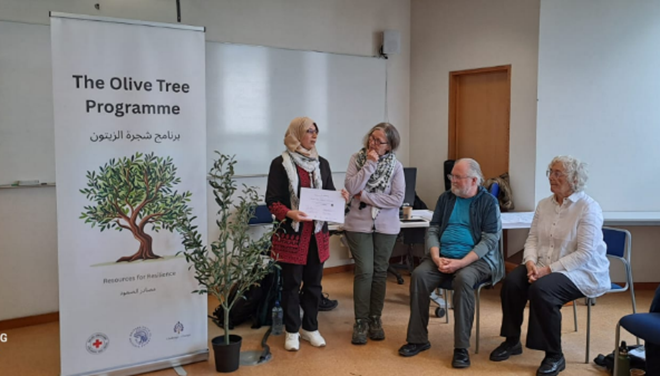
From left: Ghada Radwan, Margaret Quinn, Tom Larkin, Mary Jennings.
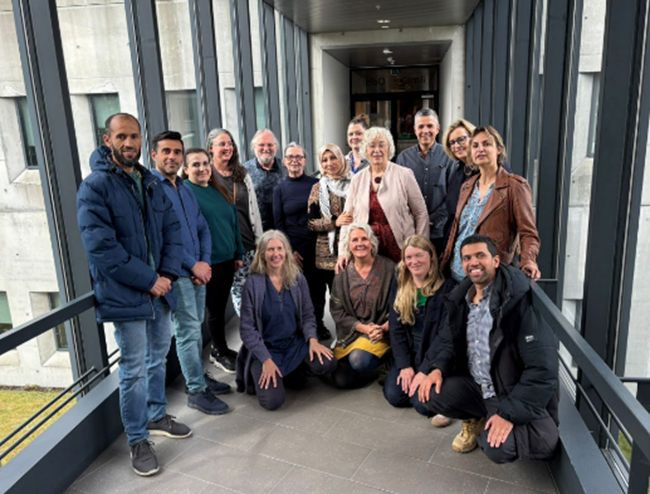
In front, from left: Guðrún Arnalds, Helga Arnalds, Guðbjörg Jóhannesdóttir, Osama
Mubarak Al Hijazy,
Standing, left to right: Ahmad Seddeeq, Mohammed Raheem, Reema Abdalhakeem, Kerryn
McMurdo, Tom Larkin, Margaret Quinn, Ghada Radwan, Elsa Haraldsdóttir, Mary Jennings,
Salah Kareem Mahmoud, Sigríður Þorgeirsdóttir, Soumia Islame
Here is a wonderful documentary on our project
IFN Committee Update - Sept 2025
by Therese Ryan
Welcome back everyone. We hope you had a wonderful summer and we’re looking forward to seeing you again very soon.
Our weekly online gatherings will recommence on Wednesday, 3rd September. Please take a moment to revisit our Guidelines as we get ready to Focus together again. If you require any support or advice in relation to these sessions, please email
Our weekly zoom sessions couldn’t happen without our zoom hosts. Many have been volunteering for quite some time. We recently sent out a request for new hosts. Many thanks to those who responded. The more hosts we have, the less often each person needs to host. Might you be willing to step forward and become involved even for a few months? If the tech side seems daunting for you, we will happily support you as you become familiar with hosting. This might be the perfect opportunity for you to contribute to our network - please get in touch if you’re interested in finding out more.
We’re happy to share the news that our Focusing Refresher evenings will return. They are a fantastic opportunity to develop and deepen our Focusing practice in community. If you haven’t come before, please join us on the last Zoom session of the month. Everyone is welcome, whether you have a lot or a little Focusing experience. We’re very grateful for our Focusing trainers who voluntarily facilitate these sessions. If you’re a Focusing teacher and would like to volunteer to lead a session, please let us know.
We look forward to seeing some of you in person at our Autumn Gathering on September 27th at the Dominican Retreat Centre in Tallaght, Dublin. Something magical happens when we come together on these days. We have two wonderful workshops planned and would be delighted to have you join us. More details below.
Next year, 2026, will be the centenary of Gene Gendlin’s birth. To celebrate this event, The International Focusing Conference will be held in Gene’s birthplace Vienna, from 3rd to 7th June 2026. Some members of the network are already planning their trip, you might like to join them. You can find more details here.
IFN Committee Update - May 2025
Our Focusing Refresher evenings have been running since last September. Each month we've had an opportunity to sense into a different aspect of Focusing in partnerships. We're very appreciative of our Focusing trainers who facilitated these evenings. The last Refresher session (and our last zoom session) will take place on Monday 30th June. Fiona O'Meara will facilitate The Power of Prompting: Ways of reflecting without interrupting the process.
Earlier this year our new Guidelines for Zoom Focusing Sessions were shared by email with all our members. The guidelines, which can be found on our website (by clicking here), were drawn up by the committee in order to nurture and maintain a sense of safety within our community and to promote respectful connection. If you haven't already done so, please take time to read the guidelines.
Finally, we are very excited to host a Children and Focusing Introductory day in Dublin with Rene Veugelers and Elaine Goggin on June 28th. We invite you to support this initiative in whatever way you can - by attending or by sharing the news of the event with your family/friends/colleagues and on social media. This day is open to everyone including those who don't know Focusing so this is a great opportunity for us all to spread the word about Focusing within our communities and to reignite interest in Focusing with Children in Ireland.
Where ever you are in the world, we wish you a beautiful summer and look forward to reconnecting with you on line in September.

Photo from our May Skills Refresh Evening with Therese Ryan
Creative Corner: I know she is with me always

It was a during a Focusing session when I described that I felt I was stuck in a maze .. not knowing if I should go forward or back. But I also seeing that there was ahead of me a hand reaching out to help pull me through. When I imagined who’s hand it was .. I knew it was my own. My wiser, compassionate self was there to pull me out of my stuckness.
So here I am in two different forms. The wiser, surer self, holding a candle to light the way and placing her hand on the shoulder of she who feels fragile or lost. And again, here I am, leaning into my wiser self, holding all my love in my hands, trusting she will care for it. We are both surrounded by birds, leaves, flowers and stars.
When do you meet your own wiser self? How does she or he show up in your life? What do you see in their eyes?
Denise Durocher, May 2025
The Folio: A Journal for Focusing and Experiential Therapy
by Tom Larkin

As Michael Caine would have said (in a cockney accent) “Not a lot of people know that” Know what? About The Folio! The what? The Folio!
The Folio certainly is a hidden treasure – it was a journal published irregularly between 1981 and 2016 by The International Focusing Institute (TIFI). The early editions were largely a collection of articles written by Focusing people about a variety of topics related to the theory and practice of Focusing, now scanned, collected together and available on the TIFI website. The later issues adopted a more thematic approach with each issue concentrating on a particular area or topic from a Focusing perspective. These are also available as pdfs on the TIFI website. In these later Folios the articles are easily accessible and can be read individually. Topics included, among very many others:
- Focusing and Spirituality
- Focusing and Fear
- Focusing and Medicine
- Focusing with Children
- Thinking At the Edge
- Interactive Focusing
etc.
The full list of what is available to view in pdf form is at https://focusing.org/folio
Each issue contains a broad range of views, perspectives, experiences and reflections, some theoretical, some philosophical, some personal, some practical and all interesting and informative. The perusal through the contents pages of each issue will reveal a wealth of fascinating articles by some of the big names in Focusing including Eugene Gendlin and Ann Weiser Cornell.
This will be especially useful for people engaging in any research or academic study of Focusing or for someone who wishes to follow a thread over time e.g. articles about Focusing and Nature or Focusing and the Body. Or for the casual, curious Focusing reader, you can just dip into an issue and perhaps uncover some gems of insight and wisdom. Whatever the motive you are sure to find something worthwhile and of interest among them.
Besides the special issue on ‘Thinking At The Edge’, some of my personal favourites, to name just a few, include:
- Resonant Sensing for Peace – Listening to Our Planetary Being by Eric Lorup and Bruce Nayowith in Vol 27 Part 2
- Heartfelt Connections by Kevin McEvenue in Vol 26
- The Implicit transformational Power of the Background Feeling in Focusing by Marine de Fréminville in Vol 21
- A Seventh Movement: The Action Step by Atsmaout Perlstein and Bilha Frolinger in Vol 21.
In fact, Vol 21 was a particularly rich volume. It was the Tribute Issue; Celebrating 30 years of Focusing 1978 – 2008.
Accessing The Folio: All Folios are available for free to paid members of TIFI however you will need to be logged in to view them. There are still some Folios are available for purchase in hard copy. Contact
Focusing and the Frequency Illusion
by Clare Myatt
If you’re reading IFN’s wonderful newsletter, you’re probably already a devotee (is that the right word?) of focusing. I most definitely am a devotee (it’s the right word for me). To say it has been transformational in my life sounds rather grandiose, but that’s the truth of it.
 From the first training with Jerry Conway many years ago, to the latest seminar given by Ann Weiser Cornell at the Somatic Approaches in Therapy Summit [April 2025], my life is pervaded by Eugene Gendlin’s seminal philosophy. It’s a bit like the red mini effect - that tendency to see a red mini then see almost nothing but red minis thereafter. Apparently, this is the frequency illusion, more accurately described as the Baader-Meinhof Phenomenon.
I recently attended one of Dr. Jim Feil’s online workshops on the topic of entanglements and getting oneself disentangled. The step from entangled to disentangled involves - you’ve guessed - pausing, taking a step back, finding exactly the right distance to be with entanglement. Hm, I thought, focusing.
I also attended one of Dr. Richard Schwartz’s online workshops on Internal Family Systems. He provided a demonstration with someone working with the part of her that says yes too quickly. In the process of the demo she identified another part which is annoyed because it would prefer to have time for more fun. Then she spent time holding both until such time as they were willing to talk to one another. Sound familiar? Looks like focusing to me.
The essence of focusing appears in poetry as well and thanks to IFN’s Marie McGuigan, I’ve found Julia Fehrenbacher’s poem The Most Important Thing. I think she’s captured the essence of focusing, as did Rumi in The Guesthouse, and John O’Donohue in For a New Beginning.
As I wrap up this review of the red mini effect, I’d like to share four words with you: “sneaky wee” and “sneaky pooh.” They do make me smile. Michael White was an Australian therapist working with children who wet and soiled the bed, and he created something called narrative therapy. His approach sought to externalise the problem - instead of the child being the problem, the problem was the problem. What a difference that made! It reminds me of Gendlin’s making space between the self and the problem:
“You welcome anything that comes…but you stay a little distance from it. You’re not in it, but next to it…you are neither running away or going into it…you sense there is space between it (felt sense) and you. You are here and it is there. You have it, you are not it.” [emphasis added]
I feel so blessed to have the red mini effect of Gendlin’s philosophy in my life. Everywhere I look, there he and his wisdom prevail. I also appreciate being part of the Irish Focusing Network - a beautiful and supportive community of like-minded folk - thank you.
BIO
Clare Myatt, LL.B., M.A., is an experienced practitioner using the lens of somatics/embodiment to inform her integrative coach-therapy. She was certified as a Focusing Practitioner in 2018, in Focusing Oriented Therapy in 2023 and published her first book in 2019 Love & Imperfection: A Therapist’s Story.
www.claremyatt.co.uk
Focusing in Everyday Conversations – a Sort of ‘Six-steps’ Approach
by Mary Jennings
May 2025
Bruce Gibbs, a student of Gene Gendlin, taught Focusing by a method he calls ‘instances’ rather than through Gene’s better known six steps. He would start his first class by asking how they might react to seeing the flashing lights of a police car right behind them in the rear-view mirror. Straight away, everyone was able to identify the visceral body-feel and the feeling-feeling of that! They recognised that sense of ‘something’ that was not, as yet, quite clear: a felt sense was forming.
He would start by first helping them elicit a felt sense, as in the example above, then support them to explore further as they became more aware of their own capacity to sense more. They were learning Focusing by exploring something that they already knew, rather than starting by having to learn some unfamiliar technique such as the Gendlin six steps.
Lessons from Bruce Gibbs’ approach
Suppose we were to follow Bruce’s example and, in everyday conversations, be in there with the notion that felt-sensing is frequently, but not always, in play and if it is not, it can be encouraged. In other words our default mode is, ‘people are felt-sensing beings - let’s treat them like that.’
You might recognise that people are in this felt-sensing mode by noticing hesitations, uncertainties (a fuzzy edge)… they may pause…. they might use phrases like, “it’s like that time when,” or use metaphors or similes – “it’s like a fly you can’t catch – that kind of feeling…”. They are searching for the felt sense of what this is all about.
In this situation, you know they are in what philosopher and Focusing teaching, Greg Walkerden, calls ‘experiential depth;’ in effect they are felt-sensing, using this innate capacity of human beings quite naturally. If it feels right, you might use some of the following ‘steps’ as gentle invitations to them explore their felt sense. These include:
Six things you can do or say to support the felt sense to unfold in others:
- “Can you say more about that….”
(when you are noticing some hesitation)
- “It’s like a fly you can’t catch…”
(Saying back the key feeling/sensing/crux words in reflective listening)
- “In the example/story you are speaking about, it is a kind of … flexibility.. you are hoping for – something like that or…?”
(giving your best guess – knowing you are correctable).
- “Have you seen that kind of flexibility you are speaking about in other situations?”
(looking for more examples or instances of what they are pointing to; this helps to allow a felt sense to come more into focus and brings greater clarity)
- “What would you like this word –‘ flexible’ - to mean here?”
(knowing words are in context and they can carry many meanings – you are allowing the person to mean what they say, here, in this situation)
- “What comes to me about all this is….
( tentatively offer something that comes from your felt sense of the situation they are describing – how their experience lands with you: It’s not advice, not suggestions, definitely not ‘let me tell you my story’! Instead, you are offering an empathic moment, one human being in interaction with another, and the person may go deeper…)
Of course, you would not use all of these ‘steps’ in any one conversation. They are offered here as a way to experiment with bringing a focusing-orientation into everyday conversations, particularly when you have the clear sense that the other person in the conversation is in a natural, ‘felt-sensing mode’ or at some level of ‘experiential depth.’
It may support them to go deeper, or to facilitate them to pause, to spend time with an often-elusive ‘felt sense of all that,’ all the while having a natural conversation.
It becomes easier when we have felt-sensing as part of our way of being. This is not about being performative or trying too hard. It has to be natural – and that comes with time and practice.
At times, this approach may be totally inappropriate or confusing for the other person. It has to come from a place of deep presence and deep listening. Below are some guidelines to help you consider when to use/not use these ‘six steps.’
A framework to guide you
Greg Walkerden has some good advice on how to go about bringing these ‘steps’ into a conversation. A summary of the framework he has developed is below:
- Wait to see if something that seems helpful comes from your felt sense
- Be tentative, make it easy for the person to NOT follow your lead
- If they don’t, relax into appreciating that it seemed like a helpful suggestion, but it’s ok if it is not
- If you feel a soft 'no' to something you are doing or are about to do, pause, back up, and freshly consider a way forward
The final word: try it, experiment, you might find your conversations become a lot more interesting!

Mary's 3 week course was well received recently with The International Focusing Institute
Worlds of Focusing: Focusing With Your Whole Body

Each Newsletter will explore an aspect of the Focusing World you may not be familiar with. In this edition we will explore the world of Whole Body Focusing.
We are delighted that WBF Trainer Addie Van Der Kooy, took time to write a piece on Focusing with your whole body.
This writing starts with a deep appreciation for Kevin McEvenue, who about 45 years ago, intuitively began combining his work as an Alexander Technique practitioner with his work as a Focusing trainer. He called it Wholebody Focusing (WBF).
For instance, the observation by F. M. Alexander that the body has to come alive as a whole in order for change to happen in a part of the body, has deeply shaped an emphasis in WBF on taking time to become aware of your body as one breathing, living whole, earthed and energised by your larger physical surrounds (ultimately Mother Earth). This then allows your body to become a safe, well-resourced holding space in which to welcome any part needing your Focusing attention.
So, let me briefly take you through what a WBF session might look like.
See yourself as a host preparing yourself before opening the Focusing door to any guests. You first of all take some time to let your body and mind unwind any tensions.
By letting yourself be completely as you are, your mind can come to rest in the Is-ness of each moment.
By simply allowing yourself to feel held by the chair and the ground beneath your feet, your body can also unwind and in that new-found space, it can come alive to its natural energetic connection with the Earth beneath your feet - a ‘six sextillion (that’s a six followed by 21 zeros!) metric ton battery. Not a bad energy supply!
You may also want to welcome a felt sense of anything supportive and nourishing in your surroundings, e.g. day light streaming into your room, a plant or a painting, whatever speaks to you in a supportive and connective way.
If you wish, you can also unwind and resource by felt sensing the flow of your breath, noticing the rhythmic release and ‘emptying out’ (exhale) and the body being re-filled with fresh, new energy (in-breath).
And, given some time, you may also begin to felt sense the ‘Hum of Life’ inside you, a natural sense of aliveness subtly vibrating as an inner energy field throughout your body - a felt sense of being alive and present in this moment, separate from thoughts, feelings, physical sensations and underlying any “packages” that may want some Focusing attention.
You’ve now let your whole body come alive in a new, resourced way; by doing so, you’ve come into a felt sense of You as Alive Presence, an embodied sense of Self in Presence.
You and your whole body are now ready to begin to host any guest that may knock on the Focusing door. There is an embodied sense of You in Presence and there is the alive, whole body into which a felt sense of your guest can be safely welcomed.
There is the fully embodied ‘You’ and there is ‘It’, the Felt Sense, and between the two there is a little distance, space. And in that space a natural interchange may occur which we call Focusing.
Quite often, deeply stored and painful places, like unprocessed trauma, need to feel the aliveness of You in Presence directly within your body. These un-processed ‘felt memories’ are stored in our bodies like time-capsules, carrying the painful ‘unfinished’ past with us into the present moment. And from their past they are reaching out for a body ‘scent’ of the aliveness of You in the Here & Now; it was exactly the absence of Presence at the time of the trauma that caused the overwhelm and subsequent need for ‘freezing over’ of the trauma.
And when you can become aware of a felt sense of the trauma place alongside a felt sense of You in Presence, a special dynamic emerges in which deep healing shifts can take place. In WBF it is called Holding Both with Equal Positive Regard. A previously disconnected trauma wound can now begin to feel itself safely held in relationship to your embodied Presence. This sets in motion a process of Homecoming or Rejoining in which the suffering place can open up and awaken to its own knowing how to move forward in its healing journey.
“When a part of me feels loved, it awakens to its own healing”
- Kevin McEvenue, founder WBF
A Homecoming in Ardpatrick – Spring Gathering of the Irish Focusing Network
by Marta Fabregat
On Saturday, April 5th, 2025, the Irish Focusing Network gathered in the welcoming heart of Ardpatrick, Co. Limerick, for our Spring Gathering, a day filled with rich connection, deep listening, and a sense of coming home.
Hosted at the Ardpatrick Community Centre, the day offered two beautifully held workshops: in the morning, Me and My Best Friend, facilitated by Elaine Goggin, invited us into a gentle exploration of our relationship with the Inner Critic, what it is trying to protect, and how it might be met with curiosity and compassion. Above all Elaine brought us to a place of joyous contact with that aspect of us that loves dearly.
In the afternoon, Rennie Buenting guided us through Finding your Way with Parts, drawing on the practice of Inner Relationship Focusing to meet and listen to the many voices within us with respect and kindness. Rennies workshop brought a sense of beginners mind, like less is more when we are listening to all that is there.
But what truly stood out was something even more powerful that took root: a profound sense of welcome. Elaine’s presence, along with the participation of her family and the wider Ardpatrick community, was woven into the very fabric of the space, creating a feeling that’s hard to put into words. It was as though we hadn’t just arrived at a venue; we had arrived at someone’s home, a place held with care, maturity, and a deep openness to whatever might unfold.
There was a kind of quiet joy in the air, a grounded warmth that made space for new connections and renewed ones, for laughter over shared meals and deep silences in shared practice. Many of us commented on the love we felt, not only from Elaine, but from the land and the people who live there. There was a sense of being received by a well-rooted, vibrant community that has found its own way of living and learning together, open and permeable. As one participant reflected, “I felt like a guest in someone’s home and also like I belonged.” That might best describe the spirit of the day that I am sure for those of us who met in Ardpatrick it will be always a memory that keeps informing us.
A heartfelt thanks to Elaine and her family in Ardpatrick for reminding us of the beauty of Focusing not just as a practice, but as a way of being together in the most gentle and ordinary way.
And thank you to all the wonderful Focusers who were there, making this such an unforgettable day.
Our next In-person Gathering will be in Dublin in the Fall: on the 27th of Septemeber 2025 in the Dublin at the Dominican Retreat Centre in Tallaght.