The Children’s Focusing Conference was held in early February and it was a conference that I was very much looking forward to. Getting to spend 3 days with like minded people who want to nurture their own inner child, and in turn support children in whatever way they can, was a very exciting prospect. And it didn’t disappoint. There were attendees from all over the world, spanning across 26 different countries and time zones, making the world a very small and connected space. It also highlighted the very different worlds and environments our physical bodies live in. These are the environments that children are born into and hope to survive and thrive in.

Connecting through Zoom and hearing from the presenters and participants, how they interact with children in different situations either through teaching in a regular classroom or supporting children in foster care, through therapy/counseling or just wanting to be there for their child or grandchildren, expands the heart and creates a huge network of support across the global Focusing community. There was a real sense of sharing and holding for each other over these three days.
The theme for this conference was Moments of Wonder and the first presentation hosted by Luzia Stefan (my room neighbour at the weeklong in Dublin!) began by offering us this:
“All grown ups were once children…but only a few of them remember it”
“By knowing Focusing we have the opportunity to remember and to value the child inside us and inside others”.
This set us up nicely for the coming 3 days! A nice reminder to let our inner child out and run amuck! Personally, my inner child was very happy to take part in all the exercises over the weekend, she’s loves to draw and colour and to allow the meaning of each moment to emerge. A moment of wonder!
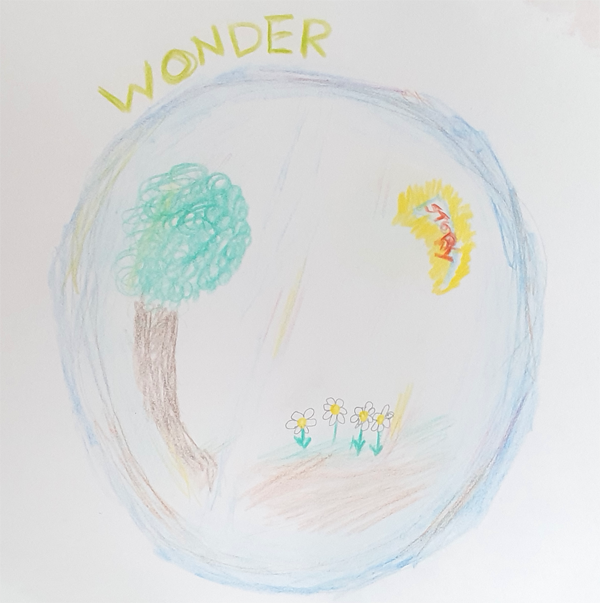 One of my favourite exercises was to create our elevators, that were going to transports us to our inner stories in our body, with the lovely Lucy Bowers. It wasn’t what I expected it to look like and it reminded me of the book from my childhood Charlie and the Great Glass Elevator, as my elevator became a bubble that traveled around having “Adventures in Fairy Land”. Lucy wasn’t feeling very well that day and was assisted by her good friend Susan Watson. And as I write this article for the Newsletter I see an email that breaks my heart a little, as I learn that Lucy has passed away peacefully. I first met Lucy in September 2022 as I assisted with Zoom for her workshop, that she gave so generously in support of TIFI, she had such an infectious personality you couldn’t not immediately love her! I am really glad she made it to the Children’s Focusing Conference that day and we got to be held in her warm and enthusiastic presence one more time. Although I had only met her a few months previous, I find tears flowing softly as I read that email. Rest in peace Lucy, I’m sure you and Gene will have a lot of fun observing us from above.
I’m sure Lucy was really happy to be there in February and was enthused by the ever growing interest in Children's Focusing. It’s so encouraging to see, through the presenters examples how Focusing can help no matter the environment and situation that the child may find themselves in. Rene gave a wonderful presentation around the inner critic that left us wanting more! Throughout the weekend we had lots of opportunities to see how Focusing has helped children, from Dance/movement to Pausing to sensing how it feels from the child’s point of view, how things are heard or received or even held.
Monika Linder gave a lovely presentation called ‘We are each other’s Environment: Imagining a Culture of Moments of Wonder’ She brought us through exercises where we allow our bodies to share with us what we felt and then check if something more comes when we hear what others have shared. The Institute has made this video available to all through their YouTube Channel and it is definitely worth a watch: https://www.youtube.com/watch?v=W30pzpXvxdY.
One of the, if not thee, highlight of the conference was the wonderful presentation from 18-year-old Anna Boukydis. Anne grew up with and very visibly embodies Focusing. Anna’s presentation was incredibly mature and beyond her years. Entitled Kids Now–a–Days, she encouraged us to connect with the inner child within us all, helping us to remember what it was like to be a child or a teenager again, and she described some of the issues that she felt her generation is experiencing and how she deals with it all in a Focusing way.

One clear similarity, that came across during the conference was the recognition of how Focusing can support a child’s inner world so they are better resourced to handle anything the outer world may have in store for them. Having supportive adults who can listen in an accepting and open way can be an essential bridge for them to really find their way in this world, while also being open to, and, creating Moments of Wonder!
Elaine Goggin
You can still sign up and view all the videos from the weekend: https://focusing.org/event/recordings-past-event-moments-wonder-online-children-focusing-conference
Remembering Lucy <3
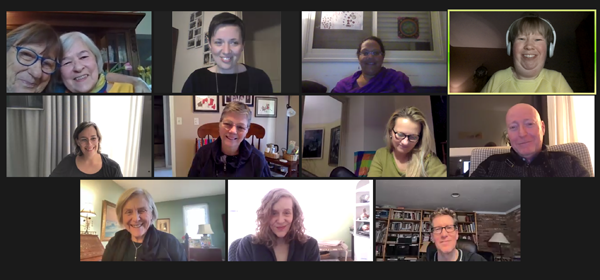
Here is a short video of the lovely Lucy: https://www.youtube.com/watch?v=W30pzpXvxdY
Sensed Ecology - Recovering the green breath as nature beings
by Marta Fabregat
I was fortunate to give my first presentation on Sensed Ecology at this year’s Felt Sense Conference.
Sensed Ecology is a term that is in emerging evolution and continues to be evolving in its philosophical findings, which I found fun to start sharing something that I am deeply passionate about and that I live and research in my everyday life through Focusing and TAE.
Whether we are aware of it or not, since childhood we have been conditioned to distance ourselves from the most organic reciprocity with the elements of nature and the relationships of support, exchange, and progression that exist in contact with the ecosystem to which we belong. Sensed Ecology is a term that I am using to describe how there is an innate belonging to nature as human beings and how Focusing is guiding our next steps towards recovering the green breath that we truly are. It is remarkable to notice how Focusing and Gene Gendlin’s deep vision was and still is an ongoing initiation into a conscious relationship with self, others, and the environment that will inspire new steps for forward growth.
From Gene Gendlin's work on Five Philosophical Talking Points (Gene Gendlin’s article Five philosophical talking points to communicate with colleagues that do not know yet Focusing) I found that these 5 points were supportive of my theory in Sensed Ecology and how we can recover the ability to function more as part of the green world we are by reconnecting and aligning our sensing capacity to that of nature.
1. Experiential Intricacy
Ecology opens us to perceive the relationship of organisms to one another and their physical surroundings, including us there. How they interact and how they are finding their next step in the relationship. Pausing - slowing down - noticing - feeling the the aliveness of the whole with us there.
2. New linguistic expressions are possible
A Felt sense implies language, not necessarily our known language but one that is still not in words. It might not even mean that it will be in words as we know them.
3. Interaction is first
As we start noticing and sensing from our experience in the present moment, life happens as being part and with the whole, forward steps start coming from an Ordinary Mind and a greater sense of being alive.
4. Experiencing is intrinsically a valuing
As we interact with our environment and life**, we cross.** Focusing invites us to listen with big ears, big eyes, great contact, and with a subtle sensitivity in our sense of smell and taste...maybe more is there that is leaning towards listening and crossing.
This requires radical humility and compassionate belonging as a new language emerges from the crossing point.
5. Thinking can be at the point of emergence of new forms
Sensing our innate ecology, our ordinariness in living moment by moment in contact with the present moment, it offers a greater landscape to carry forward as part of a greater order of things. From what we say, from what we know and have acquired from our learning experiences in our societies, cultures, and all that is from the implicit intricacy of being alive, new emergent communication, and the co-creative process becomes available for the whole. Interbeing.
This is a call to remember and to become nature, to find out our ceremony, and to legitimate our felt sensing from within our experience. From that place that is guiding us. Reclaiming back our innate relationship with the green world from our bodies in contact with all that is.
STUCK and PAINFUL by Denise Durocher
Sometimes, when I do my check-in, something feels stuck in my throat.
I’ve always thought that this is a sign that a particular something, at this particular moment needs to be expressed. The “something stuck” needs a voice.
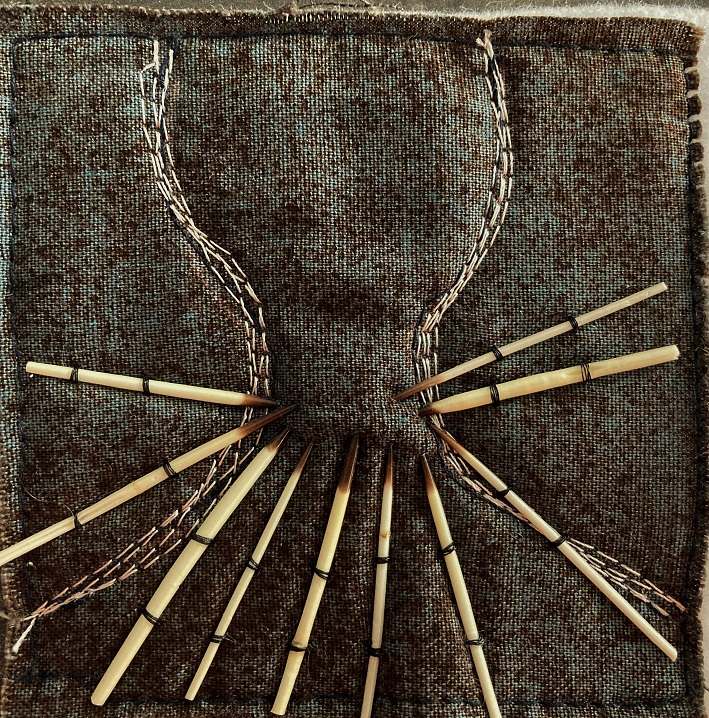
It also feels like there are a bunch of porcupine quills sticking in my throat and they hurt so much, that whatever needs to be expressed, gets discouraged and withdraws in silence…again.
With Focusing, I can tell that scared something that I hear it, that I know it is there, and that with the help of a listening partner, I can slowly remove the quills one by one.
It may take more that one session, it may still hurt, but I trust that the quills will come out and that the voice will be free.
Denise Durocher, Ottawa
Textile art piece:
Hand and machine-stitched fabric, porcupine quills, and embroidery floss.
Elizabeth English - Journeys to the Deep

“A long curiosity/struggle with meditation drew me to Elizabeth's Journeys to the Deep and her thoughtful prose and poetry both soothed and encouraged me - yes, I am on the right track; yes, it's OK this is such a personal endeavour; yes, all is well. I immediately ordered copies for a handful of friends, all of whom have shared their own gratitude and enjoyment.” My review on Amazon
I met Elizabeth at the International focusing conference in Cambridge in 2016 and was drawn to her bright infectious energy, yet an energy that was grounded and deep and somehow very wise. I discovered she “holds a ground-breaking post as [Cambridge] University’s first Mindfulness Practitioner” and was intrigued. I followed her online and was delighted to find Journeys to the Deep, the first in a trilogy.
The hundred or so pages are personal, inviting, a mix of poetry and prose, and something I return to, each time finding something new. A nuance, a deeper meaning, something fresh, a blessed aha-got-it, oh, it’s this…. And of course, constantly seeing the influence of Gendlin’s focusing, philosophy and wisdom.
As I offered in my Amazon review above, I felt profoundly reassured that my mindfulness practice was exactly that - mine. However it was, it was OK. It didn’t need to be done a certain way, or bounded by all the other parameters I’ve been taught or read about over the years. Her sweet poetry offered another way in - to wherever it is we go in mindfulness meditation - that was gentle and comforting yet thought-provoking in a bodily way. Less like intellectualising and thinking about what came forth, and more like the body being able to sense in to her words, the spaces between, images, metaphors. A truly delightful experience.
In conclusion, I’ve just read Journeys to the Deep again, cover to cover without much of a break. Well that’s not strictly true, I found myself pausing, looking out of the train window and ….guess what….meditating! Far better to take it one or two pages at a time though, that’s my usual engagement. It’s a book which lends itself to however you want to read it - start at the beginning, or in the middle, at the end, or somewhere randomly in-between. It’s like taking a lovely little break from whatever is going on, pausing as we focusers do, to sense how we are, how things are.
I have permission to share one of my favourites:
For now
Don’t wish for your mind
to be different from how it is;
Water does not boil faster
for glaring at it.
Things take their own time,
and you, too, are subject to
the laws of change.
You can only dip your toes
into the occasional puddles of calm
that collect in the dips and hollows
of your undulating thoughts.
Although a tiny droplet of peace
is all you find, still treasure it;
it is yours, and all you have -
for now.
Clare Myatt, LL.B., M.A.
Somatic Therapeutic-Coaching
Available UK and internationally online
+44 (0) 7894 714853 |
Clare’s book Love & Imperfection: A Therapist’s Story available now
https://claremyatt.co.uk/book/ and from AMAZON
A Fresh Look at Clearing a Space
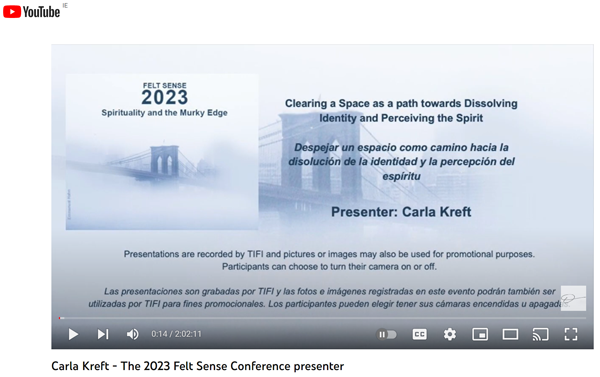
At a recent TIFI Felt Sense Conference, Carla Kreft, gave a presentation entitled, Clearing a Space as a Path towards Dissolving Identity & Perceiving the Spirit.
It was based on her close reading of the topic in Gendlin’s seminal book Focusing. “Couched in this simple exercise, it is possible to develop three different abilities”, she says:
- To experience our problems as an observer of them
- To experience great joy, love and a real sense that everything is really ok in our lives
- To be able to leave behind not only our problems but our entire identities and to ‘perceive the spirit’
The first ability is one that we are probably most familiar with, reminding us that not only this is a good way to start a Focusing session, but it is also worth doing in its own right as a way simply to give ourselves some breathing space.
Carla acknowledged that there might well be some resistance to trying the second use of CAS that Gendlin suggests. She went on to say however that this sense of experiencing joy and that ‘all is ok’ is our natural state.
The third ability, based on disidentifying from what Gendlin calls our Background Feeling, or what in contemplative and psychological practices is often referred to as ‘disidentification’, is one where she says, “if we manage to leave behind our identities then we can potentially enter a state that will permit us to come to what people call the higher self or the spirit”. Gendlin refers to it as encountering a ‘vast space’.
Carla’s presentation is freely available on TIFI’s website. https://www.youtube.com/watch?v=PY3R2OUUrd8&t=3601s
It’s well worth watching, considering and doing the 3 exercises that she lays out in a clear and engaging way. Thanks to Marta Fabregat who did the Spanish translation on the day.
Mary Jennings
 The European Focusing Association (EFA) is a European network for Focusers, Focusing professionals and Focusing practitioners, who wish to develop Focusing and the Experiential Approach through collaboration, openness and mutual support.
It is open to all who share the mutual ground of Focusing. The Association has recently launched its new website where you can explore it’s vision and aims. You will find it at https://efa-focusing.eu/
There is also a Facebook group which may be of interest. The ‘European Focusing Forum’ group is an open space for European Focusers to meet others, share ideas and experience, collaborate, get inspiration and ask questions. The group is for Focusing-related topics. Reflections, sharing, articles and quotes that promote and support self-reflection and awareness will be welcome. The group is private, which means that only members can see who’s in the group and what they post.
There is an open invitation to join the group: https://www.facebook.com/groups/efaforum and encourage other European Focusers to join too!
If you’re in the mood for a trip to Italy later in the year, check out the details of the 2023 Gathering in Bassano del Grappa, 25th – 29th October. You’ll find all the information in the February Newsletter here: https://efa-focusing.eu/2023-gathering
And if you would like to stay in touch with EFA, you can subscribe to the Newsletter, by clicking here https://efa-focusing.eu/news/newsletter/
Focusing and Dream Work
Eugene Gendlin wrote a book in 1986 – Let Your Body Interpret Your Dreams in which he said, “Love and enjoy the dream whether you interpret it or not” and which included sixteen questions was a way to find the meaning in dreams for oneself. He followed that up with two articles updating the ‘dream book’. Andrea Koch wrote Dreams and the Person-Centred Approach in 2012. There was also a Folio special on Dreams in 1992. Outside of these and a few articles in Focusing newsletters there has not been a lot of overt attention paid to dreams in the Focusing community, especially given Gendlin said that dreams are an excellent means of learning Focusing because they bring with them a fully-formed felt sense … until now that is. Leslie Ellis, a Focusing Trainer and Coordinator from Canada studied dreams, researched the dreams of trauma survivors and wrote the book, A Clinician's Guide to Dream Therapy* which blends Focusing with many other approaches to dreams.
 Ellis packs a lot into this book’s 147 pages. Drawing on the insights of neuroscience and current research, including her own, she examines dreams from many angles to provide a clear and concise map for anyone, not just clinicians, to interpret or work with their dreams. In the book she answers the questions as to why one should engage in dreamwork and how best to bring dreamwork into a practice and into life. She makes the point that dream interpretation is no longer the prerogative of a clinician but is now firmly the responsibility of the dreamer possibly with help or/and support of a listener/clinician. Having surveyed all the approaches and theories she outlines a universal approach to working with dreams.
Specifically, she asserts that,
“there is a distinct trend toward experiential methods as the main way of working with dreams. The most popular experiential techniques include telling the dream as if it is happening in the present, dreaming the dream onward, and inviting the dreamer to enter into the subjective experience of a dream character or element … there was almost total consensus that the dreamworker refrain from interpretation of the dream. Instead there was an emphasis on collaborative exploration with the dreamer, and a focus on exploring the emotional landscape of the dream.“
While there is only a short section specifically on the Focusing approach to dreamwork, Gendlin’s approach is frequently referred to throughout the book. She highlights Gendlin’s unique additions/contributions to the panoply of dreamwork approaches and techniques: finding the ‘help’ in a dream and ‘bias control’. The former is a suggestion to look for the ‘life-forward’ energy or life force that is present in every dream and she points to the various forms that such help might take as well as where to find it. The latter is an exhortation to be open to the possibilities in a dream rather than interpreting them based on what we already know. This means exploring and possibly embodying all aspects of a dream including those that may be unpleasant or frightening and not jumping to conclusions about them.
She has an especially helpful chapter on bad dreams in general and nightmares in particular, including those affected by PTSD. She shows how confronting or being able to be with the most frightening aspects of dreams has a de-escalating effect on the dreamer and that among other methods, finding the inherent life forward energy can help greatly to alleviate uncomfortable symptoms brought about by these dreams. She gives many examples of dreams and their explorations here and throughout the rest of the book which illustrate clearly the benefits of making the space and time to remember and work with dreams in an open, curious and compassionate way.
My experience of bringing this type of Focusing-oriented approach to my own dreams has been a very interesting and enlightening one. I found the suggestions in the book enormously helpful, including one where she suggests that this process works really well when people tell and explore their dreams in pairs as in a Focusing partnership or in small groups.
*A Clinician's Guide to Dream Therapy: Implementing Simple and Effective Dreamwork (2020) by Leslie Ellis is published by Routledge.
Leslie has a very interesting and helpful website with articles, videos and podcast on various aspects of dreamwork: https://drleslieellis.com/
A Perspective on the Felt Sense Conference, January 2023
One of the commitments I made when becoming a Focusing Trainer was to continue to learn about Focusing. There are many ways to do that – Focusing partnerships, reading, watching videos, going to Focusing events like workshops, roundtables, highlights, conferences etc. The covid lockdown opened up a world to us – events that were often prohibitively costly in airfare and accommodation are now accessible at a reasonable cost. There are quite a few ways from which to choose.
Every year or two there are several Focusing conferences which one can attend: the Weeklong for Newly Certified and Advanced Focusers; the Gendlin Symposium (on philosophy); the Focusing-Oriented Therapy Conference and the Children and Focusing Conference. In addition, there is the bi-annual International Conference – a general in-person event held at different locations around the world, where Focusers from all over the world convene to share ideas, insights experiences. In this piece I’m going to be looking at the Felt Sense Conference 2023.
Unlike the events listed above the Felt Sense Conference is a very accessible, inclusive online event, open to all, regardless of Focusing experience or background. It is an annual event which began in 2018 to honour the work of Gene Gendlin by exploring the many facets of felt sensing. This conference provides a space where presenters can share the far-reaching effects of Gendlin’s insights and teaching on their own lives and their work. The emphasis, over the course of the conference, is on the benefits and power of bridging or “crossing” areas of life and thought with Focusing. This year’s conference, 2023, was the fourth and the second to be online. This virtual event brought together, 15 presenters from four continents over three days to present on the theme “The Felt Sense and the Murky Edge – Sprituality”. Previous themes were Bridging Philosophy and Practice (2018), Creativity (2019) and Racial Justice (2022).
The three days were filled with opportunities for participants to listen, participate and learn; to connect across the lands and oceans of the planet; to be inspired and enlightened; and overall, to enhance their understanding and experience of Focusing. Space does not permit me to give detailed summaries of each of the 15 presentations. So, of necessity, here are just a few snapshots and hopefully a flavour of what was on offer.
Along with Elaine Goggin who ably supported the presenters, two other members of the Irish Focusing Network presented at the conference; John Keane and Marta Fabregat. John gave his presentation on “BioSpirituality and the Murky Edge - An Exploration of the Role of the Felt Sense in Spirituality”. In his presentation, John drew on such insightful thinkers as Christy Moore, Martin Buber, Karl Rahner and Richard Rohr and the two founders of BioSpiritual Focusing, Ed McMahon and Peter Campbell, through song, videos and quotes. He also drew on his own life experiences to eloquently outline the five phases of a “Foundation for a Global Spirituality” with the Felt Sense at its heart. He offered spaces throughout with prompts to take in what he had been speaking about.
Marta bilingually presented on “Sensed Ecology, the green breath within: How spiritual nature connection can affect change in our everyday focusing practice”. She began by inviting us to attune to our ‘inner habitat’ and our experience of a ‘sensed ecology’ – an experiential relationship with the environment. She, then, invited people to remember their early experiences of nature, to pick one and to invite a felt sense of that moment. With more space for reflection, she invited people to explore what prevented them from engaging with their environment. She pointed to some of principles from Gendlin’s philosophy that support the concept and reality of a sensed ecology.
In another nature-oriented presentation Peter Gill from England presented on "Nature as a doorway to spirit". Over the two hours, weaving poetry, quotes, images and music with experiential exercises, Peter took us on a journey through time and place to unfold our essential relationship with the more-than-human-world. Drawing on insights and inspiration from Gendlin and Robin Wall Kimmerer, he outlined some very doable practices to engage in nature-connection in places close to where we live.
Carla Kreft focused in on the practice of the first movement of Focusing, as developed by Gendlin with her presentation: “Clearing a Space as a path towards Dissolving Identity and Perceiving the Spirit” in which she offered CAS as “a road map to enter transcendental states”. First she clearly outlined some different prompts and approaches to CAS before going on guide some exercises which helped to explore the formulation of the words and questions that bring one to a cleared space and a place of disidentification. At the moment, Carla’s full presentation is freely available and may be viewed on youtube; https://www.youtube.com/watch?v=PY3R2OUUrd8&ab_channel=TheInternationalFocusingInstitute
Other topics and crossings included; Prayer, Zen, Spiritual Companionship, Embodiment and Symbolising. In some ways such intensive experiences of over 30 hours plus through the medium of a screen is perhaps too rich or too much to take in one go. The good news is that one has access to the recordings of these presentations for up to four months afterwards – so there is plenty of time to attend each one and to savour those that were particularly interesting or satisfying. Indeed, one can still purchase access to them – they’re available until the end of April (see below*). For me, it was (and still is) a very rewarding experience - to paraphrase an Elbow song, “one workshop like this a year will see me right”.
* https://focusing.org/event/recordings-2023-felt-sense-conference
“How are you experiencing the world right now?”
This was a question that Tom Larkin posed at one of three workshops held in Glasnevin in March as part of the IFN’s first 2023 meet-up. (The first workshop was given by Elaine Goggin and the second by Therese Ryan).
How we experience the world is usually of great interest to us all. Are we happy? Are we suffering? And if we are suffering, it’s easy to spend many hours ruminating over how to stop the pain, or ‘fix’ our lives. But, as part of a guided exercise, Tom invited us to get a feel for this whole question, which brings more than simply thinking.
Tom then invited us to draw from this ‘felt sense’, after placing crayons and paper in the centre of the room. I sensed inwardly, chose some crayons, and let the colours flow. First, came sunny yellow, then carnation pink, and then, to my surprise, thick, dark strokes of black dug deep into the page. Strong, visceral feelings flowed and I enjoyed how powerful they felt in my body. After five years of Focusing, many doors inside that have been tightly-shut are opening. My partner reflected my observations beautifully, and I resolved to buy crayons on the way home.
I haven’t used them since, because of course, it’s not the same on your own. There’s something special about devoting a day to a lovely place - and how lovely the centre in Glasnevin is - and to being with other ‘bodies’ in a room.
For what is Focusing without community? It is not the same. And whilst my deepest experiences have been on my couch, through Zoom, with many partners, I also know that sitting in the same room as others who ‘get’ this Focusing thing, whilst munching biscuits and drinking tea, is something necessary for me. I love hearing others’ take on Focusing - What drew them to it? Who have they studied with? What other practices do they like? I love talking about Focusing and often, the best way is with people in a room.
Thanks so much to the hard-working IFN committee for creating community, and for hosting workshops that stimulate, inform and bring us inside… together.

Second in-person gathering March 4th 2023
Marian Neary Burke
A refreshing start to a cold March with our second in-person gathering in the beautiful Margaret Aylward centre. What would have been a larger number than fifteen, but due to various circumstances some of our friends could not attend.
Elaine Goggin led us into the day with her lovely gentle presence ensuring a guaranteed grounding for the day and reminders about “pausing” (backed up with wonderful quotes.) Elaine also got us to introduce ourselves in a fun way, which had us glued to her heart emblem, lest we introduce ourselves too soon!
Marie McGuigan, who was due to lead a poetry workshop, couldn’t make it, so Tom Larkin, stepped in and with his usual expertise and sack full of knowledge guided us through a morning of images. The first part prompted by a question about ourselves and then taking that deeper by selecting an image from his wonderful collection of pictures. This was enhanced more with our first session of Focusing. Part two was a question about how we viewed the world now with a guided exercise, which allowed us to create our own image and focus with this. By now we were well ready for lunch, which some people saying they were so hungry, they could hardly focus!
A refreshing walk in the grounds prepared us for a lovely afternoon on the Enneagram, presented by the knowledgeable Enneagram teacher Therese Ryan. She guided us through the nine personality types and cleverly got us to experience the different energies of head, heart and gut, in a walking exercise. No question was left unexplained in her limited time to explain the complex Enneagram (especially if one was new to it) followed by further time for some Focusing.
Kathleen and Mairead were remembered several times throughtout the day. Mary Rose Crowe took a photograph of the group to be included in a documentary, which is being made for the centenary of their order, in which Kathleen and Mairead will be remembered for their Focusing legacy. Also before lunch we had a smile as we paused and using their expression, checked, " What was the weather like inside.
And suddenly it was four forty-five and Mary Jennings in her relaxed calming voice closed the day and we were already talking about our next gathering! (Maybe September!?)
With grateful thanks to all the organisers.

I had the privilege of being invited to present at The International Focusing Institute’s Felt Sense Conference 2023 – “Spirituality and the Murky Edge.”
This conference welcomed 170 participants from 30 countries.
The title of my 2-hour workshop was “BioSpirituality and the Murky Edge An Exploration of the Role of the Felt Sense in Spirituality”.
It was a wonderful experience to connect with many familiar faces and lots of new ones to explore the spirituality implicit in the Focusing experience/process.
The workshop was an exploration of Fr Peter Campbell’s (co-founder of the BioSpiritual Institute) assertion that any serious spiritual research “must” contain some dimension of the role of felt sensing.
In this workshop, we examined this assertion in terms of:
- The need for a developmental/felt sense model of “spiritual experiencing”.
- “Mysticism for the millions” creating a foundation for global Interspirituality.
- The felt sense as an essential reference in discovering “where you are” on your journey.
Space and time was provided for participants to sense into locating themselves in relation to their participation in the larger system/mystery of living.
It was so refreshing to witness how the Focusing process can form a common experiencing, a common platform that can support and nurture differing traditions and different interpretations of that sense of Spirituality. When we place interaction/experiencing first, then we can sense the value of other traditions. We do not feel threatened by other interpretations when we can sense into the living that animates them.
I left with a deep sense/hope that our experience of participating in some process/mystery larger than ourselves is the foundation for living a spirituality built on lived experience, rather than our interpretation of it.
I wish to thank the TIFI board especially Catherine Torpey and Darryl Commings for their warm welcome, Melanie Korpi and Elizabeth Cantor for their tireless organising. And especially our own Elaine Goggin for her expert technical support and kindness.
John Keane
International Director
BioSpiritual Institute
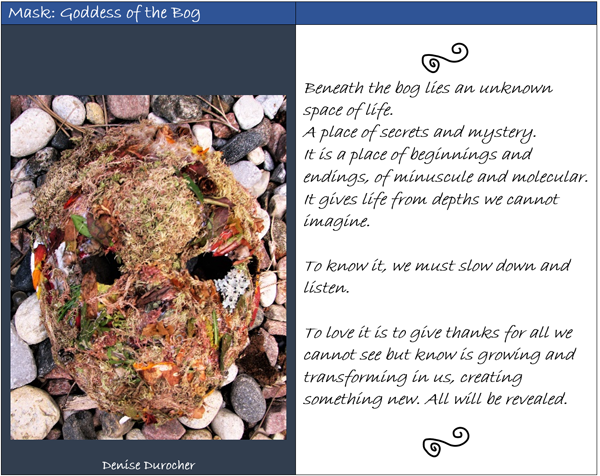
Goddess of the Bog by Denise Durocher
I have been attracted to the bog for the longest time. I feel that it calls out to me from depths unknown, to listen, to explore, to know, to honour all the life it holds: the living, the dying, and the decomposing. It is all one.
When I started Focusing, this is the image that often came to me. So once when I was walking there, I gathered some organic matter and made a mask from it.
Now, when my eyes rest on it, I remember the bog’s lesson and sit. Then in a moment or two comes the realization: “ah yes! .. there is something shifting deep inside of me, let me stay here a while”.
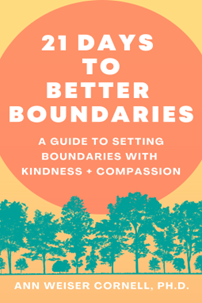 Ann Weiser Cornell’s most recent book, “21 Days to Better Boundaries” is based on her on-demand video course of the same name. It is one a person could read from cover to cover in a few hours*. However, she has designed the book, like the video course, as a daily programme over a 21-day duration. Each short chapter corresponds to a day and in each there are some background concepts, information or/and examples along with an exercise or process to engage in. Her trademark approach is evident from the get-go: the language of relating; “something in me …”; saying “Hello” to that and so on. She employs an expansive understanding of the word ‘boundary’: “It might be the line between your needs and another person’s needs, your time and another person’s time, your feelings and another person’s feelings. It could also be within yourself, between your work life and your life-life.”
Self-in-presence is an essential part of Weiser-Cornell’s approach and is seen as an underlying stance of the reader towards their inner experiences, in all of the exercises. From the subtitle of the book; “A guide to setting boundaries with kindness and compassion” it is clear that she is engaged in an inner relationship approach. She draws on other approaches when necessary e.g. employing Non Violent Communication’s understanding of needs. She explores the subtleties of indirect communication particularly in families, with friends and colleagues among others and examines the benefits of maintaining healthy boundaries. The following few chapter headings will give a flavour of situations and contexts she explores:
- Setting boundaries without anger, blaming, excuses, or apologies
- Saying no (and yes) without feeling guilty or selfish
- When wanting people to like you stops you from setting boundaries
- When people are intrusive
- Setting boundaries with yourself
- How healthy boundaries help us connect well with others
- Clear communicating that takes the other into account
Personally, I find self-help books like these difficult to utilise fully. However, Weiser Cornell very helpfully offers support for people like me by providing audio recordings of the exercises in the book on her website (for an extra $29). Alternatively, I imagine that this book could very easily be worked through in a Focusing partnership or a small group; like a book club with added Focusing time.
Ann Weiser Cornell. 21 Days to Better Boundaries. Calluna Press, 2022. Available from Focusing Resources or online bookshops for about €15.
* Which I did for the purpose of writing this review!
It is my great pleasure to introduce our Winter Newsletter. Nothing happens without the commitment and generosity of our members and we start by thanking Elaine Goggin and the Newsletter team for all the work they have done to bring this publication to your inbox.
As we come to the end of another year, The Irish Focusing Network has much to celebrate.
Online Focusing has continued – albeit with smaller numbers attending. We are extremely grateful to our Zoom hosts, whose commitment continues to make these possible. Looking to the future, we think it might be time to review the online provision. If you haven’t already filled out the survey to help us with that planning, you’ll find it here: https://forms.gle/usMaRhGdSWzo6EwC8
Marie McGuigan’s online sessions on Focusing with Poetry continue to bring joy and inspiration, as do the videos which are a popular part of the website. Check out the latest below. If you haven’t already attended the online sessions, let us know if you’d like to do so in the future – it’s a real treat. You can register for future sessions at:
September saw what, we hope, will be the first of many in-person gatherings of the Network at the Margaret Aylward Centre in Glasnevin. Caroline Moore has done a lovely reflection on the day, which you can read in this issue or by clicking here.
We were pleased that the International Focusing Institute chose Dublin as one of the in-person locations for this year’s Focusing Advanced and Certification Weeklong in October. It was particularly nice that this took place in the Dominican Retreat Centre, which was the original home of Focusing in Ireland. This was the first occasion on which the Weeklong was run as a hybrid event. You can get a flavour of how that went from Therese Ryan’s contribution. You can read her reflection by clicking here.
Some of our members have successfully completed work towards accreditation as Focusing professionals, trainers or co-ordinators. We are delighted to be able to celebrate their achievements here too.
Looking ahead to the coming year, we hope that the Network will continue to grow and to support our members in their Focusing practice. As you start to fill up your diary for the coming year, please include some of the following:
Our AGM will take place on 16th January 2023 at 7.30pm. To ensure that everyone can participate, we will hold this online. We have some decisions to make about the way forward and we encourage everyone to come along and help us to plan for the future.
Membership renewal will open at the end of January. We are grateful to all our members for their financial contribution to the Network – you make it all possible. The online system has made joining and renewing your membership much easier – a big thank you to everyone who keeps that show on the road.
We hope to welcome many of you to our next in-person gathering on 4th March 2023. We are grateful to both Marie McGuigan and Therese Ryan for agreeing to lead workshops on the day. Your reflection on the last event has helped us in planning and we are grateful to all who gave us such helpful feedback.
Several of our Focusing Trainers are offering courses over the coming months and we wish them all well in their work to promote Focusing in Ireland. You’ll find details of the courses we know about in the Newsletter. If you’re planning courses or events in the future, remember that we are happy to promote courses run by our members who are accredited trainers.
Our next Newsletter will drop into your inbox sometime in late Spring. Your contributions are what brings this publication to life, and all are welcome. Maybe there’s something you’ve read that you think others might enjoy – could you write a short review and share that with us all? Is there an area of Focusing you would like to explore with others? We’ll put the invitation out there for you – let us know. Is there something you would like to see added to the Newsletter – we welcome all of your suggestions. Email us at
Finally, we wish all our members a happy and peaceful Christmas and all that is good for the coming year. Beannachtaí an tséasúir oraibh go léir. (For our members abroad – “The blessings of the season on you all”)
Margaret Quinn
Advanced and Certification Weeklong Reflection - Dublin 2022
Therese Ryan
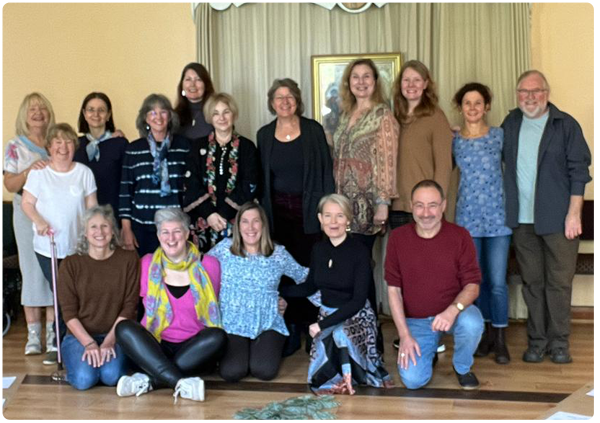
In October 2022 the International Focusing Institute’s Weeklong took place in the Dominican Retreat Centre in Tallaght, Dublin. It was the first time for this event to be held in Ireland. And what a weeklong it was. The theme was Instances of Transformation. We came together from all corners of Ireland as well as the United Kingdom, Holland, Romania, United States and Israel.
First there was the delight of meeting some Focusing friends in the flesh for the first time, having got to know each other online during the pandemic. And the joy also of making new friends, hearing new ways of Focusing, the ways people are using it in their lives. And the ease and openness that comes in the company of people who know Focusing.
Each day started with a session in our home group. This was a lovely gentle space where we shared and reflected on what was alive for us. We drew and played and danced together. And everything that arrived was held lovingly by the group.
When I realised we were going to be online each afternoon, I was initially disappointed. I wanted to make the most of our in person gathering, but I was pleasantly surprised. The afternoon plenary sessions were wonderful. We gathered with a group attending solely online as well as the other in person group in Connecticut. In breakout rooms we focused with attendees in other locations. These sessions brought an exciting sense of togetherness with the wider weeklong community. And each workshop brought something new, exciting and powerful.
We tried out Cross Lingual Focusing online. I spoke in Irish, my partner spoke in Spanish. The Focusing became more about presence and less about words. We listened and reflected differently using unfamiliar words, and as the Focuser we used gestures to communicate our wishes.
The ABC of Focusing workshop with Dan Schachter blew my mind as we explored moving from our fixed logical way of thinking towards interacting with life in an “about to be changed” way. In the Thinking at the Edge workshop with Beatrice Blake we invited instances from our felt sense of a situation and allowed new meaning to come alive and flourish. Then on the one day the sun shone, our very own Tom Larkin guided us in a beautiful Focusing in nature workshop in the grounds of the retreat centre. We even managed to Focus in break out rooms on our phones while we were outside. This session finished for me with a profound meeting with a tree.
Each evening we gathered again for informal workshops on Focusing with poetry, the process of Non Violent Communication and the Enneagram. There was lots of laughter and fun, and singsongs accompanied by Caroline on the ukulele. And we had plenty of opportunities to Focus with each other in cosy nooks throughout the building. There was time between sessions for a walk in the beautiful walled garden with its massive 700 year old walnut tree or a meditative journey in the grassy labyrinth. And some of us even came together in the mornings before breakfast for yoga and dancing.
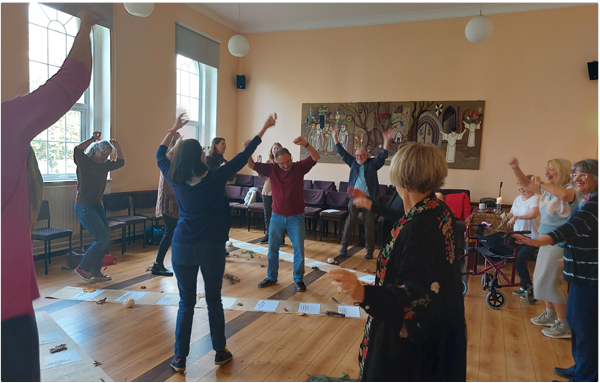
Something carried forward in our community during the weeklong — from workshops to meals to home groups and informal gatherings. There was a sense of each of us moving forward individually and collectively, agents of transformation, continually changing each other and being changed. And there was such richness in meeting different perspectives and backgrounds and ways of bringing Focusing alive.
On the last day we gathered for a special closing ceremony in a hall carefully strewn with Autumn offerings from the gardens. Five people were presented with certificates. We had an opportunity to walk a path reflecting the development of Focusing itself as well as our own Focusing journey. I left the Weeklong renewed and replenished, filled with gratitude for Focusing and the wonderful people it has brought into my life. Roll on next year!

The Irish Participants in Dublin
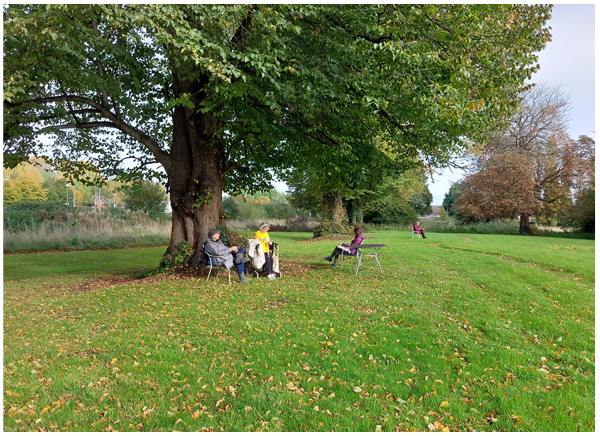
Focusing with Nature facilitated by Tom Larkin
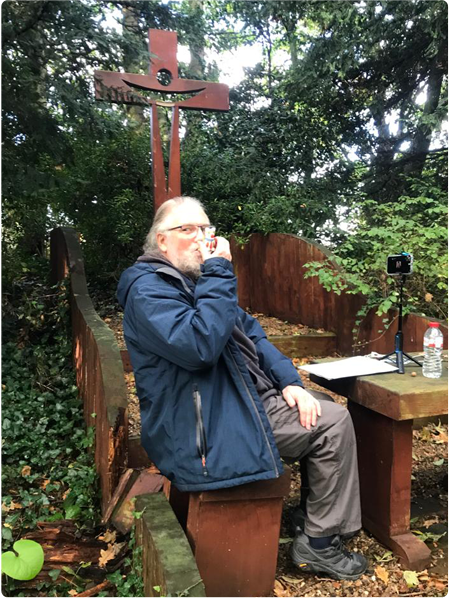
Tom Larkin calling us all back with his special whistle!
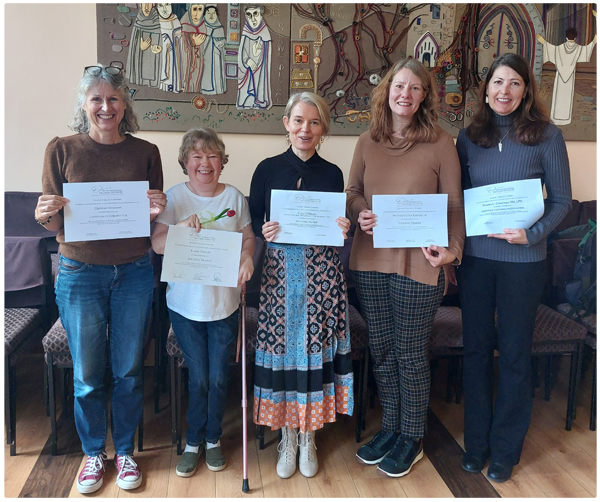
Elaine Goggin and Fiona O'Meara from the Irish Focusing Network received their certificate during the closing cermony.
A reflection on the first in-person gathering of the Irish Focusing Network
Caroline Moore
On the 17th of September past, the Irish Focusing Network held its first in-person gathering since pre-pandemic times. Held in the fabulous Margaret Aylward Centre, Glasnevin, we were treated to a very special space; with its open-plan central areas, bright, airy meeting rooms, private nooks and crannies for pairwork, and beautiful views out onto the fabulous grounds, it felt purpose built for focusing. Instantly I felt myself relax.
When I entered the tea & coffee area, I experienced such joy to see so many familiar faces from Zoom meetings and past events - in real time - with whole bodies! Remembering the giving and receiving of hearty hugs that ensued brings tears to my eyes as I write - "too long… so needed… much gratitude", are the words that come.
We settled into our 1st session with John Keane, for an exploration of Bio-spiritual focusing, based on his work with children. We were guided through a beautiful process to connect with positive times in our lives, a sort of "resource grid" of positive memories and relationships, as a grounded starting point for further work. I was excited, seeing great potential for this in my work as a teacher… though I also began becoming aware of something in me that was unsettled…
We then chose a Teddy bear from a selection, and imagined holding the Teddy as someone who cares for us has held us. I struggled greatly with this, and at the break when a friend offered to focus with me, I gratefully accepted. Oh the wonder of in-person gatherings - for my need to be seen and held, for the creation of safe space with gentle reflection, as I connected with that tender place so needing my attention. More tears of gratitude come now as I remember, and a realisation that the felt sense which arose that day almost 3 months ago is still here, but it's held with more ease and comfort now.
As a result, I missed some of the middle session, where Mary Jennings led a fascinating "Thinking at the Edge" exploration of ways of working with language to find the right word: sensing into our understanding of wellbeing; enlarging and refining it; finding group and individual understandings. I get the sense that I have not yet grasped the full potential of TAE, and look forward to deepening my appreciation.
Lunch provided a wonderful opportunity to mingle and reconnect, or take time out to wander the beautiful grounds. To finish the day, Tom Larkin took us outside, on what was a perfect autumn afternoon for his "Focusing Journey in Nature". We sat on the grassy lawns while Tom guided us into mindful presence of the sensory delights around - gentle breeze, smell and feel of fresh-cut grass, sounds of children laughing drifting across the Tolka, white clouds drifting in an expansive blue sky… We then wandered the grounds, following our inner calling of where to go, when, at what pace, what to attend to... Something about this experience was innately grounding, settling and soothing: the felt sense unearthed earlier felt cared for, gently contained and safe, held in the womb of Nature.
While still sensitive, I came away from the day feeling refreshed, with a sense of expansion, contentment and hope. Today, I am still aware of how that day gave deep nourishment to my soul - meeting a need I did not know I had - the opportunity for face-to-face connecting in real time, in a space where vulnerable inner parts knew they could be safe and seen, where all of me could be accepted as I am. My deepest gratitude to our Focusing Community for the wonder of this all-too-rare experience. X
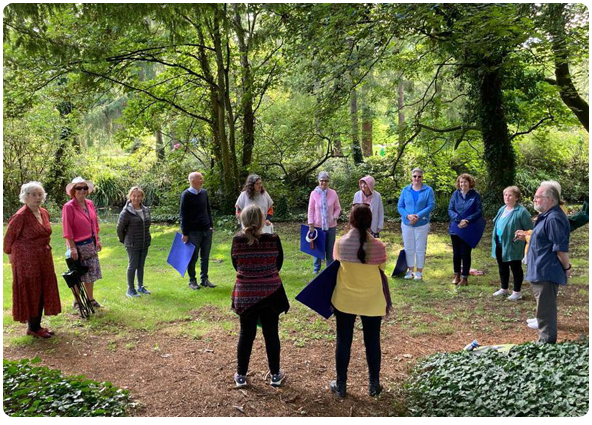
Why Read Gendlin’s Philosophy (and How to Begin)?
Eugene Gendlin was, among other things, a philosopher. His philosophical study and his own thinking was applied to his therapy practice as well as his development of Focusing and Thinking at the Edge (TAE). Reading his philosophy is not only a way to enrich our own Focusing practice, but it is a way to understand more about what is means to be human. That’s a big statement to make. It’s based on studying his philosophy over many years, usually in small reading groups where with pausing, reflecting, reading again, we considered questions like, ‘what does this say about life’? There were lots of ‘ah ha!’ moments: “Yes, I recognise that is what I do/think/act and it makes sense now!” It’s exciting!
Yes, it takes time and effort to get into Gendlin’s work. Reading in small groups is not only a good way to start, it’s companionable and enjoyable (add tea and scones to the session for extra enjoyment). And Gendlin’s own words help: the way to read philosophy he says is “many times”!
Where to start? Get together with a few people and start reading. It’s that simple. Then keep going, meaning will emerge as you wrestle with the text together. Keep it light. You might only get through one paragraph at a time, but it’s worth it. The article Margaret Quinn and I wrote in 2021, On Setting Up a Reading Group to Explore Gendlin’s Philosophy, based on our own experience of being in a reading group and on the suggestions that emerged from a TIFI Roundtable on the topic, might be useful. You can read that article by clicking here.
Gendlin also provides encouragement in his paper on FIVE PHILOSOPHICAL TALKING POINTS TO COMMUNICATE WITH COLLEAGUES WHO DON'T YET KNOW FOCUSING*. In it, he writes:“To think and talk about experience, language, the body, values and thinking is philosophy”. Focusers are already doing philosophy! This paper might be your starting text. There are other suggestions on ‘core texts’ provided in the Philosophy of the Implicit section of TIFI website. https://focusing.org/more/philosophy-implicit These should be enough to keep you going for a few years.
Happy philosophising!
Mary Jennings
*Five Philosophical Talking Points to Communicate With Colleagues Who Don’t Yet Know Focusing is available free to download from the Gendlin Online Library at http://previous.focusing.org/gendlin/docs/gol_2187.html
Ards Friary Retreat Center 
Creeslough, Co. Donegal - Ireland.
Ards Retreat Centre have agreed to become the latest BioSpiritual Institute’s Designated Centre of excellence.
The Retreat Centre lies on the Wild Atlantic Way and is nestled in 200 acres of woodland on the shores of Sheephaven Bay. The extensive grounds offer a range of woodland walks and scenic views of the shore with the hills of Donegal as a backdrop.
Mission Statement
Our mission is to offer a place of religious and spiritual encounter to
all in a place of wonderful natural beauty; and to be a community that supports nature to express itself fully, utilising the best of current spiritual, ecological and environmental understanding and practice.
Our vision is one of a world that is naturally beautiful, bountiful, just and life-giving, where we are able to remember we are all interconnected in Christ, and learn to live as brothers and sisters with all of creation.’
http://www.ardsfriary.ie/index.htm
The team in Ards is undertaking intensive training in BioSpirituality and they hope to be able to offer BioSpiritual Focusing courses to the public in the not-too-distant future.
These courses will be offered to children and adults and will include an ecological dimension that will be fostered by the outstanding natural beauty of the setting.
We hope that Ards will be a place of sanctuary and deep learning for all who are on the journey of exploring the gifts of Focusing and BioSpirituality.
In keeping with their charism of recognising the world as one community, the team also plan to make the Ards Retreat Centre a model of living in tune with the environment. Towards that end they will be offering practical and educational opportunities through hands-on experiences and courses and workshops.
Tom Larkin, a Focusing trainer will be giving a workshop on Nature Connection in autumn 2022 (dates TBC). At the heart of the workshop are the practices of Forest Bathing, a contemplative practice to foster the relationship between the human and more than human world and the Work That Reconnects, a practice that helps people move from a sense of isolation to greater participation in the web of life.
We will keep you informed about other courses in Ards, and we look forward to seeing many of you there in the future to experience the warmth and beauty of this place for yourself.
If you have any questions, please contact John Keane
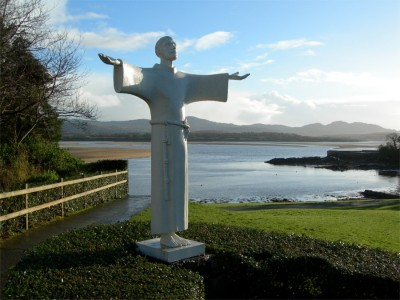
You can download a brochure for the Ards Retreat Centre by clicking here
Children and Focusing Round Table with Harriet Teeuw
Hosted by The International Focusing Institute, May 31st, 2022
Theme: Exploring Nightmares with Children
The roundtable was attended by 30 participants from across the globe including Ireland, the UK, New Zealand, India, Canada, Germany, Hong Kong, Netherlands, Hungary, Romania, USA, and Guatemala.
Harriet expertly guided the group through strategies that empower children to “play” with their dreams in a way that allows the children to relate differently to their dreams. Allowing the children to “Love” their dreams by fostering a sense that they are in charge, that this is their dream, and they are the dreamer.
Harriet explained that frequently, the initial response to a dream is that the dream is in charge but resourcing the child to own and play with the dream can change that dynamic. Returning the locus of control to the child – the dreamer.
Her first invitation to the child is to listen to the dream together – sharing the experience and opening it gently for further exploration.
Harriet has many “steps” that allow for this opening, and she shared some of the most important ones with the group. My sense is that some of the most important steps are related to addressing/opening the scary dimension of the nightmare. These steps/questions included.
- What are the nice parts of the dream?
- If you had the power/ability of the scary part – what would that feel like inside?
- Harriet explained that usually nightmares end too soon - they end without a conclusion – so she invited the question “how would the child like the dream to end?”
- Can you draw or express this dream?
- Is there anything you would like to do differently from now on because you understand this dream?
We were then offered two wonderful real-life examples of how Harriet facilitated the nightmares of a 5-year-old and an 11-year-old child. A real sense of her steps/questions coming to life in their experiencing.
This was followed by a gentle and sensitive exercise to work with our own dreams/nightmares – with time to draw what emerged. This drawing decreases the intensity of the nightmare and allows for a gentle relational distance. This provides the space for more to emerge.
Harriet then sensitively accompanied the feedback of several of the participants – providing the space for “more” to emerge. The question/step that seemed to resonate most with those adults was “how would you like the dream to end”. I am curious if the same resonance would be discovered in children.
Overall, it was a most enlightening and positive experience, and offers many possibilities in my ongoing offerings to children. The most positive aspect of this being decreasing the “scariness” of the dream, and in so doing, increasing the possibility of interaction and forward movement.
Thank you, Harriet, – and TIFI’s Children’s Team Rene, Laura and Joke.
Harriet can be contacted at
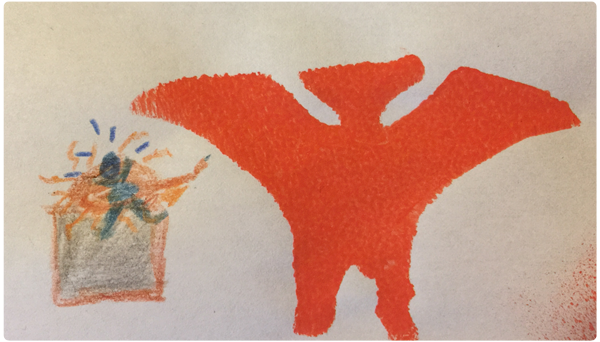
by John Keane