The International Focusing Institute
“Compassionate Conversations”
I am deeply grateful to TIFI for creating a safe zoom platform entitled “Compassionate Conversations” where members could come together to connect at this painful time in our world. There were four time slots made available and I attended two sessions on Sunday 22nd and Monday 30th October. Each session was for one hour and was facilitated by Catherine Torpey (Executive Director, TIFI USA), Veronica Urioste (Board of TIFI), Flor Sassoli (FOT Coordinator, Argentina) and Laura Bavalics (Coordinator, ILC, Hungary).
The on-line introduction stated “we are connected and care deeply for people on both sides of the Gaza/Israeli border. Many of us feel the need to express our desire for justice and peace and the right to live without violence or the fear of violence. Many of us just need to express our grief and look for signs of hope, to be part of somehow finding a way to carrying life forward”. The invitation was “to listen with a heart of compassion and to be heard in the same way.”
Before I attended the first session on Sunday the 22nd October I had been closely following the deeply shocking news coverage of violence, hostage taking and the large scale loss of life. Like many others I was shocked and disturbed. I began to sense a somatic deregulation in my nervous system. I practiced some lone focusing which in time helped me to connect with the whole felt sense of it all. I was then able to rest into it, acknowledging and allowing it all to be just there. This brought some equanimity.
Following on from this experience I was drawn to the invitation from TIFI to join “Compassionate Conversations”. Catherine Torpey set the scene as outlined in the introduction above. We gathered in the large group first and the gentle lead-ins were facilitated by Laura and Flor. I then noticed a sense of spaciousness, groundedness and safety before we began interacting.
During my first session I did not feel able or ready to share in the large group. In the listening to others, including some gentle reflective feedback from the facilitator, I began to sense a connection and belonging within this sacred space. In the breakout room I then felt able and more at ease in expressing my sense of horror, rage and helplessness, while also acknowledging my own past history of conflict related trauma living in the north of Ireland. In this space with two other focusers listening I could sense myself shift into a changed state of being in some unexplainable way. Others shared their fears, confusion, tears, sense of despair and grief/loss. On reflection I can appreciate this has helped me to process the whole impact of this experience on my life now and in the past, like one step in a process towards healing and change. I have taken some practical positive action steps in the days following this invaluable experience.
At my second session I was able to share in the large group and the group listening felt powerful. I experienced the emergence of two words “holy hope”. While these were familiar words to me I could sense direct referent freshness in it all, with the stirring of a life forward movement. Others felt the words resonate for them too which seemed to further strengthen our sense of connection and belonging with some beginnings of hope.
I conclude with a quote from “Walking in Wonder” John O’Donahue which reminds me of one of Gendlin’s famous quotes “What is split off and not felt remains the same….”:
“When things stay separate and isolated they stiffen into the act of surviving, whereas when they have a conversation with each other they begin to live as the artists of their own destiny” John O’Donahue
Marie McGuigan
November 2023
Focusing Carnival, An Tionol - November 11th 2023
Focusing always surprises! When Marta first raised the possibility of sharing our Focusing skills in a series of workshops, the Focusing Professional Class of 2022-23 was bemused. How did she think we were going to do that? The critical voices and parts were on high alert. Yet, earlier in November, that is exactly what we did. To our surprise (yes, there it is again), a crowd of Focusers, both experienced and new, turned up to our Focusing Carnival in An Tionol, Derreen, East Galway.
After some easy chat and greetings, we settled into that gorgeous upper space of the Barn, bringing hearts, minds and bodies into presence and community. We introduced ourselves and then began the first of our workshops. Kate spoke about the Felt Sense, noting the unknown, the need to pause beyond the first reaction and initial response. Her words resonated and echoed through later sessions of paired Focusing. But, first, Louise, working with her Feldenkrais skills, led us through a meditation in bodily awareness. Slowly and gently, she guided us into deeper awareness of the body, helping us to become more grounded and present to what was awake and alive in us that morning. In a brief sharing, people noted differences between one side and another, how some parts of the body were more alive than others. After a short break, Niamh led a session on Focusing with poetry. Using two poems, Prayer by Carol Ann Duffy and The Peace of Wild things by Wendell Berry, and leaning into guidelines shared by Marie McGuigan, people focused in pairs. It was a freeing way to engage with poetry, allowing the words to awaken the Felt Sense, to spill into the white blank space that surrounds the poem. Lunch was, as always, delicious, wholesome, and served with the love that we have come to cherish from Marta's hospitality. Soon everyone was chatting and getting to know one another.
In the first post-lunch session, Marta Wanczyk brought her musical experience to a workshop with sound, using her beautiful Tibetan sound bowls. During the attunement preceding the Sound Journey, Marta guided us to sense into the Field of Resonance - a space in between that contains and weaves the intricate threads of connection. Again, the attention was on the body, providing another opportunity to encounter the Felt Sense. After the session, people shared how the resonance had traversed, with grace, the expansive silence. We were well set, then, for our final session, which Caroline led. Attending to the 'Self in Presence', she spoke so openly about her experience of Focusing - the importance of holding difficult stuff, without getting lost in the emotion of it all. Her sharing was an attunement, leading us naturally into another paired session. It was amazing to see people earnestly listening, reflecting, sharing, pausing and waiting for a clearer sense of what needs to be known.
We concluded by inviting people to share their sense of the day, leaving us pleased, humbled and, in no small way, surprised (!) by how well it all had gone and how the Felt Sense can become alive through a myriad of ways. We, the class of 22-23 would like to say thank you to those of you who came along and allowed us to practise and share with you. Most of all, thank you to Marta Fabregat, our teacher, who held us together, trusting and believing in us to do our thing.
Caroline, Kate, Louise, Marta and Niamh - The class of 22/23
The Listening Path by Julia Cameron
A lot of you will have heard of Julia Cameron, hailed by the New York Times, as ‘The Queen of Change.’ 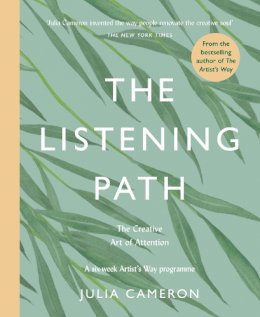
Her wonderful book The Artists Way, was first published in the UK in 1994. The book consists of twelve chapters, outlining a twelve-week course, which can be done alone or with a group. It guides you through the process of recovering your creative self. It tackles self- doubt, self-criticism (the inner critic we are familiar with in our Focusing) and time, money. and support to pursue a creative dream. The book has been translated into forty languages and has sold over five million copies.
In the meantime, she has written several other books on creativity, spirituality, fiction, plays and poetry. Has written and directed a film (God’s Will) and written her Memoir (Floor Sample, a creative Memoir).
Now she has done it again with her latest book, published in the UK in 2021, The Listening Path. Although it has the same number of pages, this book has just six chapters, or a six-week course to pursue deeper and deeper listening to ourselves, others and the environment.
The introduction, which is thirty-six pages, is a synopsis of the Artist’s Way. The first chapter is about listening to our environment, noticing, as we do in Focusing, how these sounds feel in our bodies. From the sound of our alarm clocks, the micro wave, to traffic on our commute and listening to the sounds of nature, wind in the trees etc. We are invited to keep a daily log of the sounds, noticing if they are pleasant or abrasive and checking what we might be able to do to make our auditory sounds more pleasant, Like, changing our alarm sound, going a quieter way to work etc.
The next chapter is about Listening to Others. This chapter encourages us to listen carefully and with full attention to our conversations. We are invited to keep a log of our progress and our reactions, whether we want to interrupt or give advice etc.
She interviews several journalists, novelists, musicians, actors and artists, to discover how they use listening in their careers. One interesting response from an artist who said she " listens to the sound of the brush to guide her!
I haven’t actually read all the book, so I cannot offer a detailed review. But I felt because listening is the language of Focusing it was worth recommending for a Christmas stocking filler.
The other chapters are;
Listening to our Higher Self, Listening Beyond the Veil ( That could be interesting) Listening to our Heroes and Listening to Silence.
Reviewed by Marian Neary Burke
Intro: An experiential "turn" in poetry - by Konstantinos Mavromatakis
There is poetry that turns towards the body, symbolizing inner bodily sensations and subjective experiences rather than just describing the external world. Traditionally, poets were more outer-oriented, but many now utilize their art to represent inner reality.
Several examples illustrate this newfound focus on inward symbolism. Pushkin captures struggling with inner flames of passion one tries to resist. Solomos references a hero's courage through their restless guts. Bukowski takes the reader into his body to describe experiencing a "blue bird" that he alternately relies on and fears. These poets ethereally portray subtle feelings through tangible images.
Songs too frequently blend outer events with their inner reverberations. Lyrics cited bring listeners from an outside wind into the singer's "inner home." Another example starts from the earth's core before pausing in the poet's gut. Symbolizing inward experiences seems innate and universally resonant. Even pop incorporates this perspective.
However, not all poetry centers on embodied sensation. Porcia's work remains more cerebral, showing interpersonal dynamics without physical descriptions. Still, his micro-portraits intimately depict experiences.
To conclude, the process of finding words for vague inner pre-concepts resembles psychotherapy aiding patients in symbolizing problems. Poetry historically helped comprehend the material world and now mirrors therapeutic methods in representing inward terrain. As creative curiosity defines pre-verbal realities, it coincides with treatment by giving form to formless feelings.
Book Review:
The Psychology and Philosophy of Eugene Gendlin, Making Sense of Contemporary Experience Editors Eric R Severson and Kevin C Krycka, Routledge, 2023
This book “brings together a collection of essays written by scholars inspired by Eugene Gendlin’s work, particularly those interested in thinking with and beyond Gendlin for the sake of a global community facing significant crises”.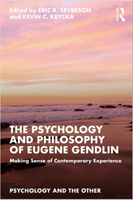
Gendlin’s philosophy owes much to his philosophical predecessors. Several of the essays tussle with how Gendlin’s work interacts with these major thinkers. It would take a philosopher to make any more fruitful comment about those discussions, so I will leave that to the more philosophically-inclined. But there is more that’s of interest.
Gendlin’s psychology was greatly influenced by Carl Rogers’ person-centred approach. One of the interesting things is how, to use a Gendlin term, he crossed his philosophical reflections with his practice of psychology to create something new, including Focusing, Thinking at the Edge (TAE) and Philosophy of the Implicit (POI).
Interest in Gendlin’s work is now turning towards what it might contribute to understanding our social, cultural, environmental and political context. Several essayists cross their work with Gendlin’s ideas. Donata Schoeller in Towards a concept of “freedom to make sense”, draws directly on Gendlin’s work on the felt-sense and TAE. Her project is to “sketch out features of a freedom that plays out in conditions that allow us to sense the problems, dilemmas and questions that arise from actual experience….. basic patterns within cultural political and economic systems… “
Robin Chalfin, a psychotherapist, quietly insists that Focusing or TAE on their own are not enough to change any system. Rather, it is essential to have a deep knowledge of what keeps systems such as racism or sexism in place as well as using felt-experience (including what she calls the ‘unfelt felt sense’ of our own biases and blind spots) to articulate what is not working in these systems: both must be in place to bring about change.
Ole Martin Sandberg’s essay on Missing the Felt-Sense: when correct political arguments so wrong is right up to date. In discussing the rise of Trump (King of the Gut Feel), he warns against too much reliance on ‘gut feelings.’ On the other hand, we might be more careful about criticising people who, on the surface, didn’t ‘trust the science (of vaccines)’ but their own gut feelings. They may have solid reasons for mistrusting a health system that is not always equitable or transparent. When we can listen to, rather than dismiss this surface mistrust, Sandberg claims, it may well be that new concepts emerge which benefits everyone. He quotes Gendlin’s Process Model :“We must permit exactly what has emerged and we must tell ourselves carefully just how we have it so far”.
Several contributors point to the need to take Gendlin’s work further, to flesh out what’s there implicitly as well as acknowledge the limits of what he addressed concerning the social and political arena. The essayists have no doubt that his work can be useful in helping address challenges facing the world. Grappling with this book might be a good place to start thinking about that.
Mary Jennings
November 2023
The Psychology and Philosophy of Eugene Gendlin, Making Sense of Contemporary Experience Editors Eric R Severson and Kevin C Krycka, Routledge, 2023 available from The International Focusing Institute book store at The International Focusing Institute Store
by Rennie Buenting
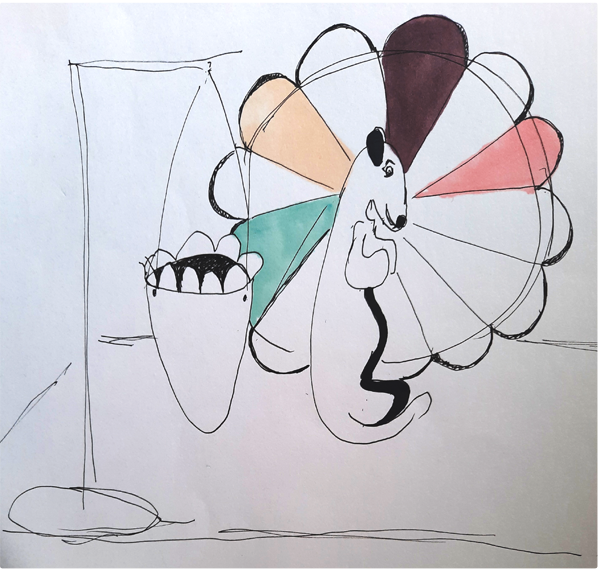
Rennie Buenting, Ireland
Art Piece
Thinking at The Edge – The aliveness of experiencing - 25th September
by Marta Fabregat
Have you ever felt that what you were experiencing about a theme in your life was too difficult to share? That the words you knew felt incomplete or insufficient to describe that experience which lives in your life? As if it was almost not possible to describe it in a way that people would understand the exact, direct experiencing that lives in you?
If this resonates with you or even if you have had many moments socially where you were trying to express something and no matter how hard you tried, despite even whether people understood you or not, there was still something inside that was not totally at ease with the expression of that experiencing. Then yes.... you get that felt experience.
I am sitting here at my kitchen table, about to bring my daughter to the school bus to Galway. Last night there was a deadline to have this article done and as I was sensing the enquiry I was embarking on I could feel the many ideas and knowledge, information coming in to be there with me from all the things I knew about Thinking at the Edge...
To write this piece for the IFN newsletter I sat with this quote from Eugene Gendlin´s article An Introduction -Thinking at The Edge:
"You need to stand again in your own experiencing ... in your own felt ongoingness, which is that intricate complexity inside of life ... to put into the world what hasn't been said yet, that you are carrying from your particular experience.”
so...how to write about TAE from my own experiencing as I sat here in front of the computer, knowing that Elaine is there waiting to receive this article to complete the gathering of all the pieces for this season Newsletter.
The first thing that comes when I ask that question is my first attempt at a formal TAE practice with Beatrice Blake. I am sitting with a task that asks me to share - in no more than 500 words - an account of a personal experience, a few paragraphs about Thinking at the Edge.
I sigh...
There is something there already about all of this, this experincing at this time, space, moment. The phrase that comes is different forces.
One force is like many things together, some of which stand firmly and congruently in line, while some are all bunched together and its difficult to differenciate among them. Things I know I have experienced ongoingly within my own process with TAE.
There is another force that is more subtle and has a strength that is very noticeable in my stomach and connected with my head. It feels like a hot air balloon with the balloon being my head with lines going down the torso and a big container that is hollow and alive in its sensation, vibrating subtlely.
The first force is really strong, it wants to “get this done!” and also knows how to do it; it has the discourse, the power with strong meaning; and it is also of course connected with previous and past experiencing.
And the other force is like - wait... a blank page - the word infinite contact comes in relation to this force and I stay here.
It seems that the quality of my sensing, or my being in contact with the different forces or paradoxical experiences is allowing the space in my belly to host those two forces and within that moment something new comes that was not there before...
It is showing me the now, in this alchemical process of birthing ongoingly from a fresh edge of direct experience.
Giving steps on how to continue expressing what TAE really is, How it can be a raw, direct and fresh-in-the moment tool for the creation ongoingly of new steps in our life, new living paradigms, and somehow it is showing me how the creation of this inner space can be created in all of us by allowing the paradox of the living moment to relate, convive and distill what is necessary for this moment.
It is new!! Hooray ….a great relief and a sense of joy and love joins my whole body. Hold on! Something more wants to join me here...its you! The reader, the listener.
Even though you are not here with me in this moment explicitly, somehow I feel you already there as an infinite, ongoing contact with this encounter.
Eugene Gendlin in collaboration with Mary Hendricks and Kye Nelson joined forces to come up with a number of steps where experiencing in Focusing could also go into the public domain.
By bringing our own personal experience, and what we all carry within us that has not been said yet and that is difficult to put into words, we may be able between us to bring about a new world, a new way of relating and ultimately a new ongoing birthing and evolution of humanity.
I bow to Focusing for this as it makes possible a life which is greater and fuller and above all because it brings me back to the intricacy of sensing life as it is...with all of that and all the more in it.
If you want to explore TAE I can only wholeheartedly recommend Beatrice Blake. You can find her ongoing TAE courses here: https://possibility-space.com/learn-focusing-and-tae/
And of course you can find much more about TAE on the TIFI Website here: https://focusing.org/felt-sense/thinking-edge-tae
And there is this article that can also bring a little more clarity... although maybe it would be better if it did not, and served instead as a great starting point to your own, unique experiencing.
https://focusing.org/sites/default/files/legacy/pdf/tae_intro.pdf
On Wednesday, 25th March 2020 we sent out an email inviting focusing friends to gather for support on Zoom. The response was immediate and overwhelmingly positive. “With quaking fingers I’ll attempt to set up Zoom. What a lovely idea” wrote one person. "Two and a half years. Has it been that long? Is that all it’s been?"
We’ve travelled quite a way since that first gathering and laid the foundations for a thriving network. “Focusing in Ireland can grow, if there’s something to hold it, the Network can do that.” was one person’s observation recently.
We certainly hope that is the case. From the beginning, though, the members of the Irish Focusing Professionals’ Support Group – a precursor to the current Network – were on hand to offer support and guidance and to take up roles in the newly emerging Network. Without their work to keep the Focusing flame alight there would have been no foundation on which to build.
Nothing happens without effort and there has been plenty of that. I want to take this opportunity to celebrate the extraordinary progress over the past two and a half years and the people who made it possible.
- Our Network has created a structure which allows us to work together, to share expertise, to support one another and to promote Focusing in Ireland.
- Our Network has grown beyond the borders of the country to welcome members from other places across the world.
- Our annual gathering online (kind of an AGM) allows every member to contribute to the development of the Network and offer suggestions for the year ahead.
- Focusers have weekly access to online sessions.
- New Focusers have been offered a supportive space to practice.
- Twice yearly in-person gatherings have given us an opportunity to connect in the real world.
- Bi-monthly gatherings online offer a space to explore Focusing and Poetry.
- Online workshops, generously offered by members of the Network, provide opportunities for further learning.
- The website has helped to make Focusing “findable” in Ireland.
- The resource page on the website is a treasure trove of focusing wisdom as well as offering a space to publish articles by members of the Network.
- Focusing courses across the country and beyond are advertised in one space.
- The Newsletter – published quarterly – keeps everyone up to date and in touch with trends and events across the Focusing world.
- Focusing Pathways – a series of podcasts created by Elaine Goggin and Therese Ryan – is a space where stories are shared, offering insight and inspiration for us all.
- A closed Facebook group has created a space for sharing information and inspiration.
It has been an extraordinary journey. One in which the creative energy, clear thinking and generosity of our community has helped to shape each step.
It is important that we ensure that the Network is carried forward sustainably. At a recent Committee meeting we addressed ways to ensure that we hold the vision which inspired this Network, build on the progress we have made to date and invite new energy as we move forward.
The term of the current committee comes to a close at the beginning of 2024, so we need to look at a process for handover which does not involve starting from scratch every three years. Our constitution stipulates that “Officers are appointed for a three year term, with a 2 year additional term if nominated. Anyone appointed for 5 years shall not be eligible for re-election for another 3 years.”
With that in mind, we will start the process of seeking out members who might be willing to be part of the committee in the future. If this opportunity is something that speaks to your heart, we would be delighted to hear from you. And don’t worry – getting in touch and expressing an interest doesn’t involve a commitment – just an opportunity to chat and explore possibilities.
-Margaret Quinn
It acted also as an urging, to me, to explore with Mary Jennings as facilitator, her on line - 'Reading Freshly: an opportunity to read Gendlin's seminal book Focusing, with others', which starts on zoom through Focusing.org on 3rd October 2023. Margaret's and Tom's demonstration was followed by the attendees focusing in groups of three using the same excerpts from Gendlin's book. The day being sunny and warm this was done in the garden.
"Your physically felt body is, in fact, part of a gigantic system of here, and other places, now, and other times, you and other people - in fact, the whole universe. This sense of being bodily alive in a vast system is the body as it is felt from inside".
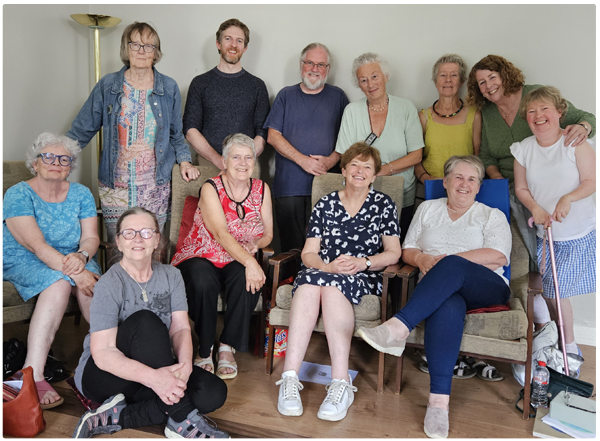
Fiona O'Meara
Many of us come to Focusing because we are suffering. And often suffering in ways that are not easily resolved, and therefore not easy to live with. I know this was the case for me, and so when I found Focusing, I appreciated it deeply.
I also then greatly appreciated meeting other Focusers who know something of this experience. Focusing is not mainstream. You have to search to find it, or it has to find you, and so we who Focus have a shared experience.
It’s no coincidence, then, that spending a week with other Focusers at the Weeklong this June felt easy. I found myself laughing a lot, and had many stimulating conversations with people from all over the world - Australia, Morocco, Switzerland, the Netherlands and even Galway.
But I didn’t just go to meet people. The day before the Weeklong, I had a challenging meeting which triggered deep and difficult feelings for me; feelings of shame and inadequacy that made me feel small and foolish.
My first reaction was to try to deny this pathetic self. I’ve so much to be proud of! I’ve done x and y and z. But such self-talk rarely works for me. And more importantly, I knew from my Focusing work, that simply trying to ‘fix’ the feelings wouldn’t lead me anywhere new. The Weeklong held that potential for me.
How? Through group work, workshops and opportunities for short partnering twice or thrice daily. In each Weeklong, you are part of a daily home group, where a facilitator holds the space for sharing on any issue that is present for you. So you can work intensively on something present.
My home group was facilitated by Beatrice Blake who shared more of her instancing work from her Thinking at the Edge workshop. I found her steps easy to follow and surprisingly effective when I later partnered with a friend.
One person in our group was honest enough to express dissatisfaction with how we were working and his courage helped me find my own. I had thought I was being myself in the group, but I saw I was just being a polite version of myself, simply ‘putting up with’ when I could in fact express more. I found that, in this way, the home group helped me to take the risk of being myself, and not feeling shame for it. I began to play with this a little, and found the group’s supportive feedback very helpful.
In the little free time that we had, a home group member held space whilst I used the body work from Ceci Burgos’ workshop, which led to more release. And, with a former Certification classmate, our Focusing relationship deepened greatly, leading to richer partnering with one another since.
So delighted to have met many people I had heard about and seen on Zoom - Catherine Torpey, Ceci Burgos, Beatrice Blake, Marta Fabregat, and more. I really enjoyed Mary’s and Julian’s workshops.
A few weeks after the Weeklong, I met the person at the centre of my shame. I noticed my body felt very different from before. Not heavy and collapsed, but bright and full and flowing, happy to be me. I’m grateful again to Focusing and to Focusers for all the wonderful carrying forward that occurs when we sit and listen.
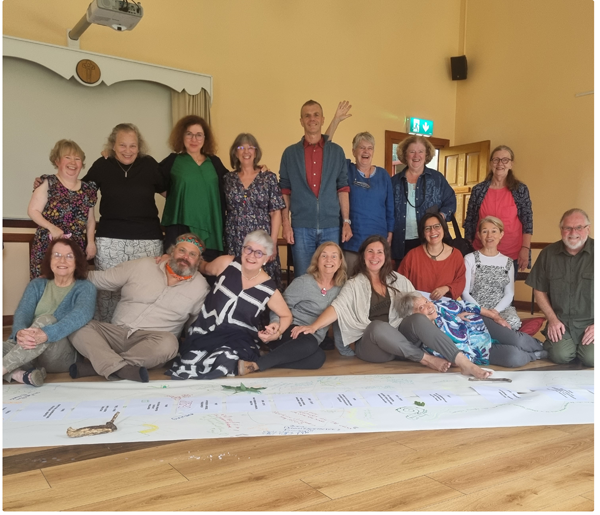
Group Photo at the end of the ceremony (not everyone is in it but most of us were!)
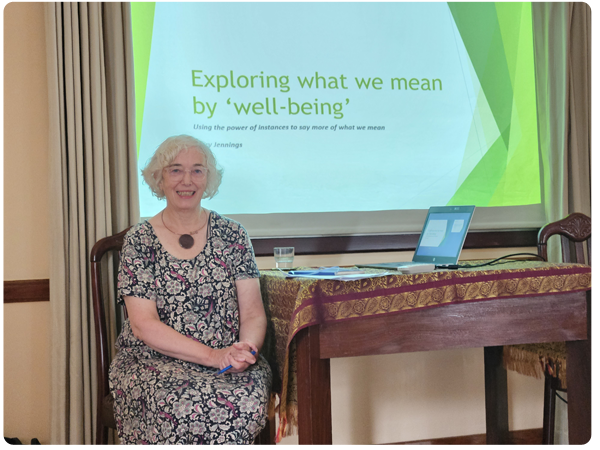
Mary Jennings presenting her workshop on the Monday evening
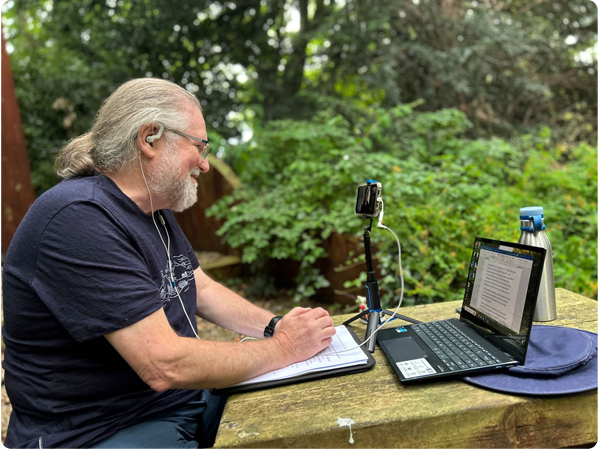 Tom Larkin hosting his Plenary on Focusing and Nature

Some fun in the evening
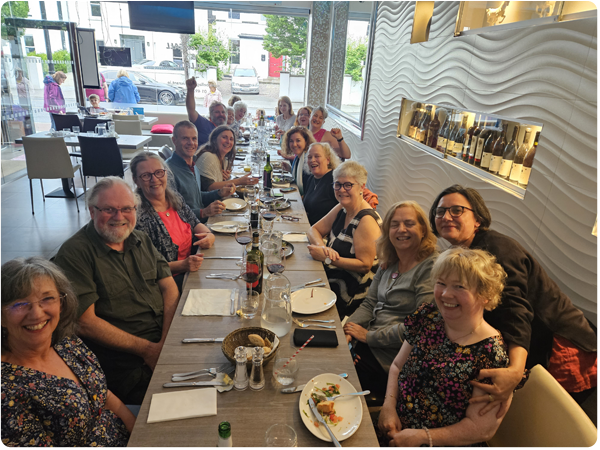
On the last evening we all shared a meal in a local restaurant
A personal review by John Keane
This article is a summary of a detailed reflection available on the IFN website. Click here to read the full review
Many Focusers encounter a difficulty in sharing the “idea” and “experience” of Focusing with friends, family, and colleagues. It is my hope that this review will help in this respect.
I offer the following as a reflection on the complexity of Gene Gendlin’s exploration of how we can have bodies that explain how Focusing is possible.
- Many people will translate what we say into concepts they are familiar with and comfortable in using. So, if we say that Focusing is about the body and feelings, then they may translate that in a different way than we intend. Gendlin illustrates that he is talking about the body in a very different way than it has traditionally been understood, and that feelings are different to what many people understand because when we talk about feelings in this context, what we are pointing towards are the doorways to a more intricate and complex form of living that may emerge from the felt sense.
- The body that Gene is describing is the body as it is sensed from the inside. He offers us examples of how we can build the complexity of that body in a manner that goes beyond the traditional understanding of the body as a physical structure that is mainly a transportation system for the mind.
- This body “knows”, but it does so in a different way than the mind “knows”. As complex human beings living in a complex world, we need the precision of both kinds of “knowing”.
- The body that Gene explores in relation to how Focusing is possible, is an interaction with its environment. This interaction is evident in all of the phases of the human body that he describes i.e., the plant body, the animal body, and the human body. When we begin with interaction then we sense the world in a different way – we sense a world that includes us and our experiencing.
- The culture we live in spends so much time developing our capacity for conceptual thought but has forgotten its capacity for bodily knowing and carrying forward. This is not something we add onto human living – it is already there, and Focusing offers us the means to access and develop this capacity.
- Sensing into the questions is more productive than finding answers in our living. The questions can imply a deeper living – a way forward that the answers can never offer. There is a wonderful paradox implicit in the Focusing process, where it is the stoppages and questions that can offer us the possibility of living more creatively. For me there is a freedom and a hope in that possibility…
We can all become poets and live in a way that is full of creativity. When I teach Focusing to children – I tell them that I will offer them something that most adults don’t know – this peaks their attention. The younger children know Focusing in the marrow of their bones, but the sad thing is that we educate them out of it. So perhaps we can all become children again in this way…
I have called this programme of Focusing in Nature: Green Breath. Focusing, resonance and nature. Green Breath – Sensed Ecology Programme consists of 4 retreats and personal initiations during 4 of the main Earth seasonal festivities.
The initiation and accompaniment in the process of *Sensed ecology* began in February 2023 during the time of Inbolc and continues until November 2023, during the time of Samhain where the process is completed.
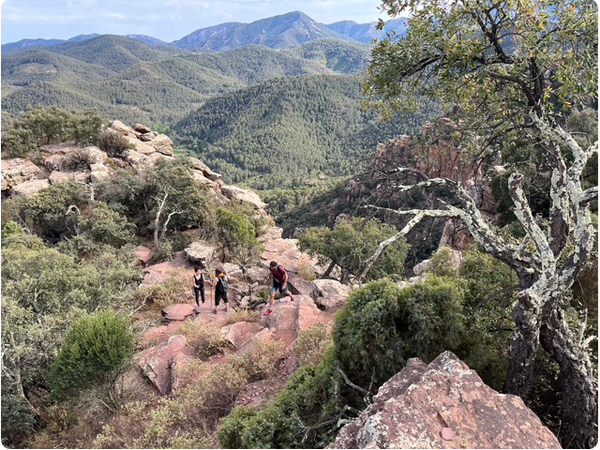 *Green breath* is not a set of healing formulas or techniques learned and repeated over time. Each retreat is a unique experience for each person in relation to the plant, with the time of the earth season, all in connection with resonance for the land and the people.
Due to our close symbiotic relationship, we share common ground with the plants around us. Our lifegiving connection to green beings is inherent in our humanity.
The natural medicine of plants and the emerging communication with green beings is a powerful, soft and kind antidote for the condition of disconnection, isolation and loneliness to which we are subjected without wanting it and too often without being aware of it. Plants are initiators in learning to accompany us, and ecologically accompany life - to be in connection, in privacy, from a new place, present and in contact with the ecosystem which we are part of moment by moment.
In May we connected with Hawthorn in Sierra Espadan, South East Spain. Being with plants and in general with nature in the context of Focusing brings a subtle, gentle and delicate attunement in a person experience. It requires to slow down to the resonance of nature and find within us the space to welcome its vibrating communication and its longing for connection.
Our next retreat is in August and this time we will be welcoming Oak, a common native and ancient tree of Ireland and Spain. Part of the retreat is walking in pilgrimage and fasting with the medicine of the trees for 36 hours. This gives a real opportunity to connect with the plants without distractions and interference.
Hawthorn medicine is connected to the Heart, is the great compassionate ally in the plant world. Supporting us to regulate our heart rate and our whole nervous system and heal our circulatory system. It supports union, communication and authenticity in our path for connection with others and life just as it is.
Green Breath is a call to remember who we are as people, Focusing takes us by the hand and whispers... Remember....and the trees are there, just at the right moment of readiness to share their vibration of medicine with our receiving inner home or, inner musical chamber. Resonance does the rest.
We just have to enjoy the beauty of what is and what is possible.
By Marta Fabregat
Introducing our brand new IFN Focusing workshops! As part of your Irish Focusing membership you now get to avail of the opportunity to register and attend our latest in a series of online Zoom workshops! This is a new initiative untaken by the Irish Focusing Network Committee to support our members and also support the network. There is a small fee of €10 that is divided between the host and the network. Our workshops plan to be on Tuesday evenings between 7.30 and 9pm but this may vary depending on the availablity of the hosts and other events which may conflict with the schedule. You will need to be a member to register for these workshops.
We began with a very successful workshop on Moving Forward with the Enneagram with Therese Ryan last month. We already have 2 very exciting workshops planned for Autumn and Winter. With Rene Veugelers and Harriet Teeuw giving an 'Introduction to Children's Focusing Workshop' in October and Denise Durocher and Reenie Beunting giving a workshop in December on 'Creative Spirit Focusing'. We are very excited for both of these and more details will follow shortly.
In the meantime, please read this review of our latest workshop from Marian Neary Burke, who we are very grateful to for taking the time to write this.
Enneagram - Moving Forward with the Enneagram Workshop
After her informative presentation at our in-person meeting, Therese agreed to do a follow up on Zoom. For €10 (some of which went back to the Network) we had a wonderful hour and a half of Focusing with the Enneagram. We worked on the wings and the arrows. The wings are the numbers either side of the number we recognise as our personality type and the arrows are the numbers to which we move for growth.
Therese herself agreed it is hard to decide how much information to impart in a work shop (as she likes to share as much as she can). Some would have liked more time to Focus, so Therese agreed the next time she would have less content and more time for Focusing.
Despite the time limit, it was an excellent workshop, very clearly explained. Therese cleverly selected words, to describe the personality of each number. (For example, responsible, trustworthy, energetic, empathetic etc) Having Focused with the words, we chose one that resonated with us (From our wing and arrow number). This was a very simple, useful way to show us what we need to do for our growth work. I love the Enneagram as every time I attend a workshop, I learn more about myself and my relationship with others.
Marian Neary Burke
Making Connections
We as the Irish Focusing Network were so delighted to see this workshop come together. A big part of our philosophy is helping people connect together and this workshop was a perfect example of how people who have a common interest can come together and create something valuable to them while also creating a wider space for people to enter and explore together. We are also delighted to see that they will be offering a workshop in person this September (See below) and a number of online Zoom session workshops. Little shoots everywhere, as they say mighty oaks grow from little acorns. We wish them an expansive and vast space to explore.
Rennie Buenting
On several occasions during IFN meetings Tom Larkin had asked if anyone would be interested in getting together to look at ‘working with dreams’.
So, a few months ago, Tom, Marian Burke, and myself got together and focused with some of our dreams. We loved it!
Marian has a big interest in dreams, and has tried out several ways of working with dreams.
Lately she had worked with Jeremy Taylor’s method. Tom has recently followed a dream course with Leslie Ellis. My own experience, apart from studying some of the dream theories through psychology, has been with dream focusing workshops, which I found very helpful.
We liked our dream sessions so much that we decided to organise a Dream Taster Workshop for everyone that was interested, and possibly a longer workshop at a later stage.
In the taster Marian Burke gave an overview of the historical background and Tom Larkin talked about Eugene Gendlin’s approach and his 16 questions.
We suggested to work with a few of these questions, and after a short demo, everyone had the chance to get into the break-out rooms to focus on a dream they had brought.
Following on from this we are working towards organising a weekend ‘in person’ workshop, as well as a number of zoom session workshops, so that whomever cannot make the ‘in person’ workshop, can come to a zoom series. So for those of you interested, you might like to start writing down your dreams.
The best way to remember a dream is to have a notebook ready beside your bed, so that you can write down your dream when you awake. Lying still in the position you wake up in, helps to recall as many details as possible. Then write these down. You don’t have remember all of the dream to be able to work with it.
Start practicing and watch this space for more information on the next Dream Workshop!
Marian Neary Burke
Expressing our interest in dreams (through the newsletter) brought Tom, Rennie and myself together, which resulted in the workshop.
Here is feedback from some of the participants.
“I had a little difficulty grasping all the information. I had a fragment of a dream, and when we went to Focus, I was a bit anxious about remembering all the instructions. However, I put all that aside and was amazed and surprised in my session. I had a profound experience by simply giving it attention. I had forgotten how dreams represent where we are in our lives. I thoroughly enjoyed it and look forward to doing more”
Another. “A dream is alive and wants to be carried forward by our interaction” (Gendlin). This set the tone for the evening. I enjoyed the history of dreams and the presentation of “Dreamwork Movements,” with the guided questions. I had a profound experience in relation to one character in my dream, revealing more from a past life experience. I have downloaded Dr Lesley Ellis free book, from the resources shared at the workshop. The experience has continued to connect me more consciously, with my dreams in a deeper way.”
One more. “It was great to reconnect with my dreams. The research and background were very interesting. I am writing out my dreams now and staying with the felt sense.”
I would encourage anyone with a topic, to get together and offer a workshop.
Any Dream Will Do … A 2-Day workshop on Focusing with Dreams
Facilitated by: Rennie Buenting, Marian Burke & Tom Larkin
Where: The Dominican Retreat Centre, Tallaght, Dublin 24.
There is plenty of parking space available there and the centre is easily reached by public transport from central Dublin. Website: www.retreats.dominicans.ie
When: Saturday 23rd & Sunday 24th September 2023. Time: 10:00 am - 4:00 pm each day
Cost: €120:00 (includes lunches on both days, teas, coffees etc.)
Accommodation/B&B is available in the centre at €60 per night
Note: If are interested in this topic and you can’t make this workshop, we intend to offer a five-evening online version in early 2024.
Closing date for bookings: Friday 15th September (unless the places are filled before then)
For enquiries, deposits, booking etc contact:
- Rennie at 086 3898061 or
This email address is being protected from spambots. You need JavaScript enabled to view it. - Marian at 087 970 3640 or
This email address is being protected from spambots. You need JavaScript enabled to view it. - Tom at 087 2734475 or
This email address is being protected from spambots. You need JavaScript enabled to view it.
The setting was Ards Friary in Donegal, Ireland. The natural beauty of this place established the environment where 15 strangers gathered to explore the process of BioSpiritual Focusing over 6 days.
The weather was beautiful and invited us to rest in the splendours of nature – surrounded by 200 acres of woodlands and set directly on the beach.
As we explored the foundations of the process, it became apparent that each participant was different in their experiences and understandings of Focusing and BioSpirituality. It was encouraging to see how each person began to take responsibility for their own process – living from where they were now, rather than where they wished they were.
As our bodies began to sense the safety of the group – we were gifted by the individual stories that each person courageously shared. It is miraculous to witness how our willingness to share our vulnerabilities creates the space for grace and transformation. As Fr Ed often said, “That which we protect from our own knowing, we also protect from God’s grace.”
The energy of the group shifted palpably on the 3rd day when we experienced a new exercise created by Louise and Joe Colletti called “Your Affection Timeline”. The impact on the group was that of recalling experientially the gifts of love and gentleness on their journey, and many commented that it was also an exercise in gratefulness. The direct impact of this exercise was how it facilitated the holding of “the affection teacher within” in a more fluid and natural manner.
As a facilitator, it is so exciting to witness the shift in energy that emerges organically when the community of those gathered comes to the fore and they begin to carry and support one another. The individuals become a community of love and healing. It is also interesting to see the physical transformation in the participants as they come home to themselves, to one another, and to the beauty of nature.
An aspect of this experience that also played a crucial part was the community and staff of Ards Friary. The Franciscan Capuchin community in Ards welcomed us into their home. Their hospitality and kindness, and the way that the group were treated by all the staff added to our sense of being at home. And of course it is important to mention how well we were fed – I was glad that there were so many beautiful walking trails to work off some of the wonderful food.
I am forever grateful for this life enhancing experience, and I carry each of the participants gently in my body, thankful for how they have gifted my living in their own unique ways. I needed to sit with an inner sense of loneliness as we went our own ways, but that has shifted into a sense of how privileged I am to share this gentle and life enhancing process.
by John Keane

Each Newsletter will explore an aspect of the Focusing World you may not be familiar with. In this edition we will explore the world of Children’s Focusing.
In my experience, children already have a vibrant sense of Focusing. Our education system and our culture etc often distance them from this vibrancy.
What a gift it would be if we could maintain this capacity in our children. Enabling them to enhance a sense of value and meaning within their own bodies, rather than having all valuing external to their own living.
The International Focusing Institute have understood the value and need for this enterprise and have a section of their website dedicated to the area of Children’s Focusing https://focusing.org/children-focusing/children-and-focusing
As you will discover from the above link. This community is active and passionate about the importance of sharing Focusing with the next generation.
I have had the privilege to attend the 2014 International Children’s Focusing Conference held here in Ireland. As well as presenting at the 2022 online conference and hosting a Children’s Focusing roundtable discussion in 2023.
I have had the opportunity to share Focusing with children in schools, as well as with my own daughter. I can honestly say that I have always learned more than I have ever offered in these gifting experiences.
If you are interested in this area of Focusing – a good place to begin would be with Marta Stapert and Erik Verliefde “Focusing with Children: The art of communicating with children at school and at home.”
Marta was a wonderful lady with a passion for sharing her wisdom with children and those who care for them, and is deeply missed by the Focusing community.
Mary Jennings had an early influence on the development of Children’s Focusing in Ireland. We are delighted to share some of her memories of this here.
John Keane
One evening in 2009, in All Hallow’s College, René Veugelers from The Netherlands, was in Dublin, giving a workshop on Children Focusing. It was a one-off event, part of a fundraising drive for a Focusing project in Gaza. René, in his inimitable way, offered ways to really listening to children, their hopes, their fears, their inner sense of rightness, in a natural and gentle way. And it was fun!
Later that evening, news of yet one more report on child sexual abuse in Ireland was published. A sense of deep anger arose in me, hearing yet again of how we treated our children in Ireland. Then, an epiphany: what if we had a way of really listening to children, giving them skills to trust their own instincts, what might happen? We had just been shown a way just this very evening! Instead of anger, I felt energised! What if there was a way to bring Children Focusing to Ireland to change the situation? René readily agreed to come and offer training. With a generous grant from the Irish Focusing Teachers’ Association (forerunner to IFN), over the next 18 months, 20 people were trained in the practice of Children Focusing. Among them were parents, grandparents, teachers and people working in children’s services.
Many of them are current members of IFN, who have used their training in Children Focusing in many different ways: listening to their own children and grandchildren in every day life; devising programmes in schools using Focusing, working with foster parents and children in care to improve services and relationships. Some have gone on to take further training in the practice and can train others to use Focusing with children in so many ways.
It was a start. A small bag of seeds. It would be great to think that, with regards to children that ‘all is changed, changed utterly’, but there is more to be done; let’s keep going.
Mary Jennings.
Review of “Senses of Focusing, Volume 1”
edited by Nikolaos Kypriotakis and Judy Moore and published in 2021 by Eurasia Publications, Athens, Greece (565 pages).
Weighing in at over 1.2 kgs, this is one brick of a book! The contents are weighty too. There are 26 articles by Focusing writers from across the globe, exploring a very wide range of Focusing topics. The editors have very helpfully, loosely categorised these into seven sections. Equally helpful and most interesting are the snippets of Gendlin’s own spoken words that act as introductions to each of the seven sections. These have been extracted from the videos that Nada Lou made from Gendlin’s talks at various events between 1998 and 2007. [The videos from which these were transcribed and extracted are all available on Youtube see: https://nadalou.com/gendlins-spoken-volume-1/ ] This is not a book to be read like a novel. It is more like a buffet where you can sample the contents through an abstract and then zero in on the one that most resonates with you at the time. This was my approach and it has taken me well over a year to read (and in some cases reread, then read again) all of the articles in this first volume. Many of the authors are therapists, some are philosophers and others neither. Three of them have given workshops or/and course in Ireland (Ann Weiser Cornell, Joan Klagsbrun & René Veugelers). Among the many topics written about are the practice of Focusing in different forms and cultures, the felt sense, the direct referent, the body in Focusing and some applications of Focusing in different settings and situations. As such this book is a treasure chest overflowing with gems and jewels. Every single article has something interesting, challenging, insightful, fascinating or/and impactful to impart, ponder and savour.
No, I don’t have a favourite! However, I will take just a few of the articles and say a bit about them. The introductory article by Judy Moore, “What is Focusing and where did it come from?” provides some fascinating background information on the origins of Focusing from the perspective of Gendlin himself and others who wrote about their experiences in the University of Chicago in the 1950s and 1960s, including Carl Rogers. Judy concentrates on the period from when Gendlin joined Roger’s group in 1952 until the late seventies by which stage Gendlin had formulated the ‘six movements of Focusing’. One thing I found particularly interesting was how Focusing came to be unshackled from its psychotherapeutic moorings. It would appear that during a major project begun in 1957, Gendlin and his colleagues started training non-professional volunteers, ‘ordinary’ people to help patients Focus “on the felt edge of experiencing”. This insight then informed the operation of the Changes groups of the 1970s in Chicago and other cities and indeed has gone on to make Focusing accessible to the many thousands who have brought it into their lives.
There are some intriguing article titles e.g. Focusing with Elephants in which Alan Tidmarsh points to the ‘elephant in the room’; the big issues that dominate the news headlines (Racism, Brexit, climate change, fake news etc) and those that never make it into the limelight, both of which are never really resolved and yet influence and impact on our personal and social realities in myriad ways. He says that “owning up to elephants is the challenge of our time”. He takes something Gendlin said in a 1966 article as particularly inspiring, “…even though we may have given up in our own lives we must turn back from having turned back…” In this regard he proposes three “superior” practices: Pausing, Noticing and Owning up. While we may all be familiar with the first two of these, he is asking us to take a wider, more wholistic perspective, “giving the elephant in the room the space it needs to be more connectable”. The third practice, owning up, is a call to authenticity – “the discovery of a personal truth that can then be carried forward”.
Another title that I was drawn to was Focusing is not a ‘thing’ in which Sarah Luczaj appeals for Focusing not to be ‘commodified’, formally packaged in programmes and organisations – she asserts that “Focusing can’t, through professionalism or in any other way, really become a thing, assume a fixed identity. It can, however, be treated and used by individuals as if it were”. As an aspect of this she highlights some people’s preoccupation with whether or not what they are experiencing is a ‘felt sense’. She, like others in their articles (Gendlin included), point to Focusing as a natural process in which most people engage to some degree or another. She acknowledges the tension between recognising Focusing as a natural process and the practice of training people how to use it. Taking her inspiration from Buddhist and Daoist practices which facilitate awareness of ‘the natural state’ she suggests that focusing can contribute to this through the first movement of Focusing, clearing a space, more specifically, a practice that “keeps us in the state of clearing a space” and which provides the welcoming conditions for a felt sense to arise.
And this is only the first volume! To even list the other articles’ titles would take up too much space, however, one can find out more about this wonderful, informative book and the contributors by going to a website developed around both books at https://sensesoffocusing.com/ There are also video presentations by, and interviews with, some of the contributors.
Becoming a Member of the International Focusing Institute
The International Focusing Institute (TIFI) is an international, cross-cultural organization dedicated to supporting individuals and groups world-wide who are teaching, developing and practicing Focusing and its underlying philosophy.
What the Institute does:
TIFI is committed to advancing the work of Focusing’s founder, Eugene Gendlin, and those who have built on his legacy.
TIFI promotes Focusing and encourages its application in a wide variety of settings.
TIFI is a hub for information and education about Focusing and Gendlin’s philosophy, as well as a catalyst for research on Focusing.
TIFI provides many opportunities for connection, dialogue and interaction among Focusers around the globe.
A personal note
When I became a member of the International Focusing Institute (TIFI) it was partly to support it’s work in promoting Focusing, but mostly because it was a requirement for certification as a Focusing Trainer. And then the pandemic happened….
Like everyone else, I was at home, restrictions were severe – remember when we could only travel 2 kilometres from home? For a while it was actually fun to explore what was within that limit. And I enjoyed finding creative ways around what was (or was not) available in the shops. But the limitations were trying too.
Then two things happened…
Mary Jennings suggested that we invite Focusers to gather online, and you all know how that story unfolded.
And I discovered TIFI “highlights” and “roundtables”! Suddenly, membership of TIFI was about a whole lot more than fulfilling a requirement for certification!
During that first year of the pandemic, I took part in the first online “weeklong” – an opportunity that I could not have availed of in person. I learned more about Gendlin’s philosophy, I developed a new interest in strands of Focusing that were new to me, and I met Focusers from all over the world! Now, I can’t imagine not having that connection to the world of Focusing. Membership of TIFI has opened doors, offered opportunities and created connections I could not have imagined in pre-covid days.
If you would like to support the Institute, here’s some information from the website:
Who Can Join?
Both Focusing Professionals and others who want to support Focusing are warmly welcome to join our vibrant global community. “Professional” membership categories are for those who are training or certified by TIFI to share Focusing with others as teachers, trainers, or therapists. Others may join in the “Affiliate” categories of Friend, Supporter, or Associate.
Benefits of TIFI Membership
TIFI members enjoy a wide array of benefits and opportunities, including:
- Discounts on TIFI-sponsored workshops.
- Free member-only events and online gatherings with Focusers around the world.
- Increased visibility with your profile in TIFI’s online Directory and “Find a Focusing Professional” search engine. (Professional members only).
- Publicize your Focusing workshops or Changes groups on TIFI’s website. (Professional members only)
- Free and low cost Focusing-related educational opportunities.
- Connect with other Focusers through TIFI’s email discussion lists and our website's new member-to-member search.
- Find a Focusing partner through TIFI’s Partnership Network (for qualified members only).
A full listing of the many benefits of TIFI membership is available at www.focusing.org/membership
Cost for membership can be found at https://focusing.org/membership/schedule-prices-membership-certification-and-pfp-award-effect-january-1-2022
Above all, your membership of the Institute is a way of promoting Focusing through education, research and community building.
by Margaret Quinn
|
Orts
|
From the orts,
|
|
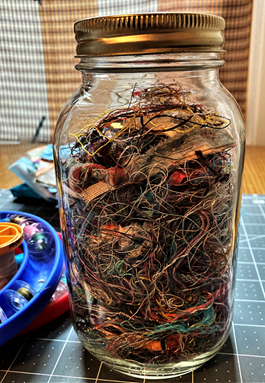
Throughout the years of working with fabric, embroidery floss, scraps, and pieces, I learned that the snippets of threads, bits and bobs, are called “orts”. Reminds me of how I am sometimes before a Focusing session. |
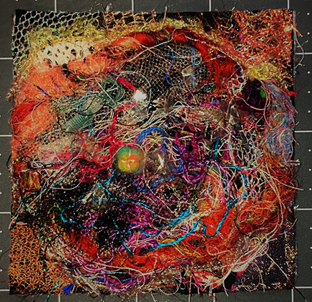
Fibre art piece made from fabric, batting, orts of all sorts, including a soft centre of wool roving, and shiny pieces of mica. Thanks to all the Focusers who have helped me make sense out of my mind’s orts. Denise Durocher |