by Tom Larkin
From the west, north, east and south of Europe 30+ Focusers gathered in Humboldt-Haus, Achberg for the annual European Focusing Association gathering. This year the theme was “Surfing the waves of life; sensing and thinking freshly”. There were participants from eleven [European] countries with English as the agreed, ‘common’ language.
Humboldt Haus is situated in the heart of the German countryside from where could be seen green fields and forests all the way to the Alps. Many German Focusers consider Humboldt-Haus as the ‘home’ of German Focusing because this is where Focusing really took off in Germany 30 years ago and where Eugene Gendlin gave several workshops - a portrait of him hung on the wall of the meeting hall during the event.
Fiona Parr (UK) initiated the proceedings, describing the EFA as more of an “associating” than an association; there is a steering committee, but it doesn’t have office holders, doesn’t have a bank account etc – a grass-roots group.
While there was a loose structure to the schedule, space was made for daily Focusing exchanges, open spaces, home groups and ‘personal’ spaces in the afternoons. The evenings were for dancing, singing, talking, or whatever. Outside of these there was no prearranged programme for how we would spend the time together. Towards this end, time was provided for whatever participants wanted to bring to the gathering - at the first whole group meeting on Thursday, there was space for participants to offer “happenings” i.e. workshops, roundtables, presentations etc. and, after some haggling and jostling for particular times or rooms (done in a Focusing way of course), the timetable quickly formed around these offerings. For every space in the schedule for Happenings there were between three and five choices of topic.
Topics included:
- Focusing with Images
- Focusing research
- ‘No content’ Focusing
- Felt sense dialogue around climate change using Appreciative Inquiry and Dynamic Facilitation.
- Smartphones and Focusing
- Spiritual bypassing and Focusing
- Focusing and ‘hidden’ Illness/condition
- Reading the last chapter of Focusing: ‘Experience beyond Roles’
- One’s own experiencing of the climate crisis
- Dreams
- Focusing window for Ukraine
- CAS + TAE + Drawing
- Etc.
As always in these situations I found myself wanting to be in at least two places at the same time! I usually come away from Focusing events feeling enriched, my understanding of Focusing deepened and my skills enhanced, and this gathering was no exception. When I consider the question of what my highlight was though I’d have to say it was meeting with, and making heart-felt, in-person connections, with others who have a deep-seated interest in and commitment to Focusing. There was so much richness, not alone in the more formal spaces but in the sharing and discussing over meals or on walks around the beautiful surrounding area.
As my network of connections grew, the world became a (relatively) smaller place for me over the course of the gathering and since.

For your diary - the next EFA gatherings:
2025 Belgium 17 – 21 Sept
2026 Scotland 23 – 27 Sept
More information about the EFA, the subgroups and about how to become a member etc at
https://efa-focusing.eu/
by Niamh Pattwell
On a bright late September morning, we found our way to the Dominican Centre in Tallaght for the IFN in-person gathering. Like magic, people materialised in front of us, flesh and blood, no longer pixellated Zoom versions of themselves. For some of us, this was our first time to meet in person. It was good fun: people were bigger, taller, smaller, not exactly the shape one had imagined. Over a welcome cup of tea and coffee, warm greetings were exchanged, connections and reconnections were established.
Capturing the Autumnal inward turn of the year, Caroline Moore led us in an attunement. Then, our first session ‘From Fear to Flow: a Focusing Approach to Speaking in Groups’ was led by Fiona O'Meara. Fiona invited us to imagine a situation where we might give a public talk and, through a series of quiet reflective exercises, led us on a journey to sense what it is that we might want to say. From there, we tried to sense what it is that we want from the experience which, as some of us discovered, might be a deeper need than what it is we have to say. It also invited contact with what it is that holds back or prevents us from speaking freely. During Fiona’s session, we didn’t focus in pairs, but there were opportunities to share on what was emerging for each of us. Not only did I leave this session with some sense of what I might say in my imagined situation, but also with a very real sense of the parts that were alive as I listened for what I wanted to say - the message of the speech was not the only facet wanting to be heard! It was deeply touching, then, to hear a couple of participants, give a short two-minute presentation, arising from the workshop. The sincerity and conviction brought a presence that was fluent and inspiring.
After a tasty lunch and a short stroll in the Autumn sunshine, we returned for a second session in which Marie and Elaine invited us to focus with poetry. Marie, in her introduction, spoke of her first experience of focusing with a poem which came as an unexpected surprise while she attended a Focusing event in Dublin many years ago. When Marie heard someone recite Mary Oliver "Wild Geese” as a part of their presentation she explained how her whole body came alive in some unique way. The words landed inside, stopping time and space, bringing a real felt resonance to something in her that needed to be heard and felt deeply. Elaine on the other hand described her initial hestitation when Marie invited her to focus with a poem as this brought memories of school days and ‘learning off’ poetry and then having to analyse it. Feelings of inadequacy arose in her. Her experience resonated with many in the room. However she described how she was pleasantly surprised at how powerful focusing with a poem could be and she experienced a new freedom and connection with the words and tendeness that only a poem can bring.
Marie offered some gentle guidance, and followed by a demonstration with Elaine, we soon were scoping out quiet corners to focus with our chosen poems and partners. As always, the poetry surprised - parts coming alive in the earlier session took on a new form here in a poem where childish perception bumped against adult experience. Everyone returned to share their encounters, refreshed and excited, I think, by how much easier it is to access these esoteric chunks of rhyme and verse through direct personal engagement. Focusing with poetry brings a reading that is both personal and, somehow, universal.
It was a beautiful day! A gift! Thank you to our Committee who organised it all.


"Without some people who listen, it is hard to hear oneself." Gene Gendlin
Our Focusing Refresher course got off to a flying start in September. Our purpose in offering this course is to provide an opportunity to pause and explore what is important when Focusing with another person. We hope that providing a space to sense into the vital aspects of partnership will deepen and enrich each person’s practice and develop our Focusing community.
Each Focusing Refresher evening is facilitated by a trainer from our network. Each month we explore a particular theme. Marta Fabregat started us off in September with an evening devoted to grounded aware presence and deep listening. In October Kay McKinney developed the theme of listening, invited us to sense into how it feels to be a listener and how to look after ourselves while listening.
On November 25th Elaine Goggin invites you to join her and explore how to look after yourself when you feel uncomfortable with your partner’s approach to listening. It’s no surprise that discomfort might arise when people who have trained differently in Focusing come together in partnership. But how might such a situation be managed and even become an opportunity to grow as a Focuser?
Each Refresher evening begins with a little teaching and discussion around the theme. Participants are then invited to Focus in breakout rooms paying particular attention to this theme. The time to Focus is shorter than in our regular zoom sessions. Afterwards there is time to reflect on the theme and share insights and/or experiences.
We warmly invite you to join a refresher session whenever you can. All members of the network are welcome — whether you’ve attended the weekly zoom sessions regularly, occasionally or not at all. They take place on the last zoom session of the month and will continue until at least March. You’ll be notified by email in advance of each evening.
We would love some feedback about the Refresher evenings. Are they helpful? What do you appreciate about the evenings? Is there a theme you’d like us to explore? Please get in touch.

Here are the dates and themes for the rest of 2024.
Monday 25th November 2024
Mind Yourself Now!:
Exploring your own way of looking after yourself and your parts when you feel uncomfortable with a different listening approach.
Elaine Goggin
Monday 9th December 2024
Taking in & Saying Back:
Exploring how the Listener can support and enrich the Focuser's process by reflecting.
Therese Ryan
by Bernadette Shepherd
Date: 11th-12th May 2024
Facilitated by: Mary Jennings, Margaret Quinn and Tom Larkin
Venue: Dominican Retreat centre, Tallaght, Dublin
Title of workshop: Deeper Presence – More Possibilities, enriching our understanding and practice of focusing.
This workshop was a wonderful collaborative focusing weekend workshop, underpinned by lively interactive discussion and demonstrations. Set amidst beautiful magical and peaceful grounds which enhanced the workshop Focusing principles.
The main theme of the weekend was the way in which the process of focusing help me in everyday life. The three presenters Mary, Margaret and Tom made complex theoretical approaches come alive through engaging delivery, live demonstrations and interactive activities; all were received well by the group. It was powerful to observe these demonstrations delivered by experts whose quality of presence deepened the groups understanding of the techniques and spirit of Focusing. The interactive nature of the workshop enabled me to practice with other participants, and challenge myself to establish new habits, I have since been able to translate these new approaches into everyday life and ork.
The presenters created a safe environment enabling a deeper connection amongst the participants and with the material itself. The participants who were brought together in this workshop were from a variety of backgrounds and experiences, this diversity brought a quality of presence and aliveness to the discussions.
This was a very full, exciting and alive workshop, with engaging presenters who embodied the theory and practice of Eugene Gendlin’s Focusing theory practice and philosophy.
Thank you Margaret, Mary and Tom for such an inspirational and experiential weekend.

by Denise Durocher

The teacher instructed us to use our Chinese brush with a very light touch, as if we were a bird flying down to water and flying right back up again.
I made cattails.
Black ink on a white background, bleach on a dark background. One single stroke to make the stalk and furry bit, two more for the leaves. Whether I am adding light to the dark or dark to the light, both paintings need the two elements to “work”. Without the light or dark background I wouldn’t see the light or dark object. Similar to the Yin and Yang symbol.
In Focusing, I know that most times I start out by mainly sensing the dark, and with the help of my Focusing partner, feeling it, naming it, holding it and giving it a voice. And then, usually, light comes, bringing with it lightness. I see something more clearly and it leads to a lighter feeling inside. Something has changed … even if only a little bit. Thank you my all my dear Focusing partners.
(Denise Durocher, India ink, Bleach, on Watercolour papers)
The Path of the Sensing Being Retreat
There are moments in life when the ordinary transforms into the mystical, where the mundane turns into a profound experience that resonates deeply within us. As I sit down to write about the "Sensing Being Retreat" that took place at the end of April in Olympus, Turkey, I find myself pausing and sensing. It has been two months since the retreat, yet the essence of that experience continues to inform my present moment, shaping my now in subtle yet significant ways.
Writing about an event that still feels alive, even after time has passed, is an act of capturing a living, breathing moment. It's about recognizing that the experience is notnconfined to the past but continues to unfold within me. This process of naming and articulating a forming happening is an encounter with the mystical in the midst of the ordinary.
During the retreat, we immersed ourselves in a Focusing living experiencing as a community of living beings. This heightened our awareness and deepened our connection to the present moment. In pausing and sensing we were met by the mystery of how this could be possible…being fully present with whatever was arising. These may seem simple, but it opened the door to a profound realization: that life is constantly offering us moments of implicit occurrences, subtle yet powerful living processes that shape our being and our belonging to the moment.
The "Sensing Being Retreat" was not just an event but a journey into the heart of what it means to be alive and present. Each day, we engaged in everyday moments that encouraged us to tune into our senses, to feel the textures of the world around us, and to listen to the whispers of our inner landscapes. These moments of deep sensing brought about a mystical ordinary, a space where the boundaries between the sacred and the mundane blurred.
The retreat was part of our in-person Professional Level Training. We gathered in Turkey to support one of our members who is from Turkey, embracing the opportunity to strengthen our global community. There is a special interest in bringing Focusing to Turkey from our friend Ceren, who works in the community sector, particularly with refugees in different areas of the country. This retreat was a testament to our collective commitment to expanding the reach and impact of our practice.
On the first day of meeting the new people who were joining us for the introduction into Focusing, we all went to a very special place close to Olympus, a mountain called Yanartaş. This mountaintop natural wonder is where ancient myth and scientific phenomena collide. The eternal flames found there have been burning for thousands of years. According to legend, the Chimera, a deadly three-headed beast, was the source of these flames. A Lycian king sent Bellophontes on his winged horse, Pegasus, to destroy the part lion, part goat, and part snake fire-breathing monster. Bellophontes plunged his spear into the Chimera and buried it deep into the mountain, where its fiery breath still
burns today.
What happened there was a unique moment of joy and pure healing presence. As we sat there as a group to share the initiation of our time together, a firefly sat on top of one of the Turkish participants. This simple yet profound moment brought more stillness and calm beauty to all of us. It was a reminder of the awe and silence that occurs when we simply belong as we are.
The title "Fireflies in My Hair" is a metaphor that captures the essence of my experience at the retreat. Just as fireflies light up the night with their gentle glow, the retreat illuminated my inner world with moments of clarity and insight. These fireflies are like sparks of wisdom and understanding that continue to dance in my consciousness, reminding me of the beauty and mystery of life.
During the retreat, I felt as if these fireflies were weaving through our hair, symbolizing the transformative power of the experience. Each spark represented a new awareness, a deeper understanding, and a more profound connection to myself and the world around me. These moments of illumination have stayed with me, continuing to light up my path as I navigate the journey of life.
Writing about the "Sensing Being Retreat" has been a journey in itself, a process of reconnecting with the alive happening that continues to inform my present moment. It is a reminder that the mystical can be found in the ordinary, that profound experiences are woven into the fabric of our daily lives.
As I carry the fireflies in my hair, I am reminded to pause, to sense, and to be fully present with whatever is arising. The retreat may have ended, but the path of the sensing being continues, guiding me towards a deeper connection with myself and the world around me. The fireflies from the retreat illuminate the ongoing interconnected life that there is at all times, showing us the lasting impact of living a life of sensing the ordinary, perceiving the biology of our interweaved ecosystem.
I am sensing how the group that met in Turkey while reading this will also feel here what we all shared. The ordinary that occurs noticing the something that can´t be spoken. As Focusing companions finding ourselves marveling in the mystery of the paradox of emptiness and the eternal way of meaning forming. Special thanks to all the practitioner level training 2023, the beautiful Turkish friends, all of them!! And Paula Charnley from the Uk who joined us as a companion trainer all the way.
I love when what I’m reading stops me in my tracks and I have a bodily sense that it matters to me. I’m guessing you all know this experience.
Recently, I re-read Ibsen’s A Doll’s House (1879). The play caused outrage at the time because of the final act. Nora, the respectable wife of a respectable husband, leaves him - and her children - in order to find herself.
As I read that final act, I could feel something stir inside. Nora and Torvald have the first real conversation of their marriage, resulting in her waking up to herself, and seeing for the first time how she has been merely acting a role, living as a ‘doll wife’ in a doll’s house created for her by the men in her life.
The phrase reminded me of an expression used, so many years later, by Timothy Leary, a former Harvard professor in the 1960s, in describing his first experience of LSD.
LSD gave him new insight into his relationships. His interactions with his daughter had been robotic, not alive. They had been relating to one another like two ‘dolls on wheels’ squeaking back and forth. They were merely living out roles society had prescribed for them, like little dolls.
It’s clear to us now in 2024, that in 1879, people were conditioned to play certain roles - the role of devoted wife, sweet mother, hard-working father.
What resonated with me is how hard it can still be to know who I am apart from my conditioning. But Focusing has helped me with that.
I was always intellectually aware of being constrained by my conditioning, but I could not feel the aliveness that was me. Focusing has helped me experience myself.
I like how Carl Rogers put it: "the client can let himself examine various aspects of his experience as they actually feel to him, as they are apprehended through his sensory and visceral equipment, without distorting them to fit the existing concept of self.”
It’s immensely freeing to notice and feel your own experience as it actually is, rather than trying to make yourself feel something else.
When Nora declares she is leaving to find her real self, her shocked husband, Torvald, asks if she will return. I loved her reply: “How should I know? I’ve no idea what I might turn out to be”.
Yes, how could anyone who is committed to knowing themselves know who they might turn out to be?
This reminds me of another keystone in Focusing philosophy - we are not fixed entities, but rather, we are ‘in the process of becoming’. We cannot ever know how that will turn out.
I love how the arts or stories can stoke something in us.
Are you reading anything right now that is stoking something in you?
If yes, maybe it is a worthy starting place for a Focusing session.
In-Person Spring Gathering on Saturday April 20th, 2024 in Derreen, Gort
By Peter Duffy
The Irish Focusing Network held its Spring Gathering on Saturday April 20th at An Tionól Cottage, Derreen, Gort, Co Galway for a day of workshops, focusing, and connection. This gathering was the first one to be held outside Dublin, and what a wonderful place it turned out to be. As we arrived the sun was shining, the first spring flowers were bright in the fields and meadows, and the trees were almost green everywhere. We were deep in the countryside of east County Galway, making our way down narrow country roads between grey drystone walls. At this stage, all twelve of us knew that we were a long way from the M50! I am writing this piece some two months later and without any notes, so my recollections have a lot of blank spaces.
Our hosts for the gathering, Marta Fabregat and Marta Wanczyk, welcomed us at Derreen and we chatted briefly in the two-roomed wooden barn, which was to be our location for the day. The barn was at the edge of a native woodland, and the trees seemed to bring a calming presence throughout the day’s workshops.
Marta ran the morning workshop called ‘Wholehearted Communication: Felt Sensing what we mean.’ This experiential workshop combined Focusing with the work of Marshall Rosenberg, who developed Nonviolent Communication (NVC). NVC develops practical communication skills, provides a model for NVC by breaking communication down as an interactive process of speaking and listening from an internal/external experience of ‘request –-need--feeling—observation.’ After Marta’s workshop we worked in pairs, following the NVC steps. NVC works very well with Focusing because they both complement each other and come from a place of empathic listening. If you are interested in finding out more about NVC, a good place to start is with Nonviolent Communication: A Language of Life, 2003, Rosenberg, M.

Before the afternoon workshop, we had a delicious vegetarian curry for lunch, followed by tea, coffee, and more chat. (Thank you, Marta.)
In the afternoon, Marta Wanczyk, lead us in an exploration of sound and resonance, using handheld gongs. Marta started the workshop by playing the gongs as we sat around the room. Then she invited us to choose a gong. (I liked the look of the smallest gong, and grabbed it straightway. Mmm…I’ll focus on this later. )
We each moved around the room, playing the gong, and sensing where we should stop and resonate, listening to the sounds and sensing where we should move next. It was a really interesting way of combining sounds with Focusing.

Thanks to Marta F and Marta W for a wonderful day in Gort, two fascinating workshops, and extending the possibilities of Focusing. After writing this article, I realised that both Marta F and Marta W were following the path that Eugene Gendlin envisioned for Focusing: ‘Please don’t spend years under the impression that Focusing is all that one needs. We need to learn many methods for developing ourselves along many dimensions.’ (Vision Statement for Focusing: Action Steps and Projects, 2003, Gendlin.)
Our new IFN committee has been exploring ways of growing and developing our community including providing a welcoming space for those who are new to Focusing as well as those who feel rusty in their practice.
One of our first initiatives was to invite Gordon Adam from the British Focusing Institute to an online evening with our community. Le Chéile: Growing Focusing in Ireland took place on May 21st. Gordon described his decades-long Focusing journey and shared his rich experience of developing Focusing in the community including the Changes group of which he has been part of for seventeen years. Gordon invited us to drop in the words “Focusing Community” and to Focus in break out rooms, bringing a curiosity about what these words meant to us as individuals as well as members of the Focusing community. Gordon connects deeply with poetry and his reading of the Rumi poem “Be with those who help your being” was a warm and beautiful conclusion to the evening.
We are planning other initiatives for the Autumn including a monthly listening skills programme. If you have some ideas about how we might grow and develop our Focusing community, please contact any member of the committee. We’d love to hear from you.
If you’d like to hear Gordon speak about Focusing, you can listen to the latest episode of Focusing Pathways.
The IFN Spring Gathering took place in Gort, Co Galway in April. Much gratitude goes to Marta Fabregat for hosting this event. This was the network’s first time to get together beyond the pale and it was a wonderful success — so much so that we’d like to explore the possibility of holding a weekend Focusing retreat next year. If you know of any suitable venue down the country please get in touch with one of our committee members.
In the meantime we’re preparing for our Autumn Gathering in the Dominican Retreat Centre in Tallaght on September 28th.. A beautiful day of workshops, connection and of course Focusing is planned. We’d love to see you there. More details and to register click here.
Our weekly online Focusing sessions on zoom will take a pause during the summer and will return in September. We’re grateful to our zoom hosts who generously give their time to hold this space.
We on the committee wish you all a wonderful summer wherever you may be.
Focusing Refresh Evenings Coming in September
The themes of building community and supporting our Focusing practice emerged during our AGM back in January. Since then the IFN committee has been exploring ways in which we might encourage more of you to join our weekly Focusing sessions on Zoom and support members who wish to deepen their Focusing experience.
Some members of the Network have expressed interest in joining the online sessions, but are a little nervous about doing so. Others may feel a little rusty in their Focusing practice. With this in mind, we're delighted to let you know about an opportunity to learn and develop together.
From September the last Zoom meeting of each month will be a "Focusing Refresh" evening designed to help members develop and practice Focusing partnership skills. These sessions will be led by some of the network's Focusing Professionals and Trainers. We hope that reminding ourselves of the essential aspects of Focusing will help build confidence in your ability to listen deeply to others. Every member of the network is welcome to attend, watch out for our reminder emails in the Autumn.
The pandemic brought so many challenges back in 2020, but there were also some gifts. It was during this time that some of us began to explore online courses and workshops offered by the International Focusing Institute. During the isolation of Covid restrictions, these were an opportunity to connect, as well as providing wonderful learning opportunities. Among the offerings from the Institute are the “Roundtables”.
Unlike courses and workshops, each Focusing Roundtable is designed to promote informal peer-to-peer conversation. Rather than acting as expert presenters, the Hosts serve as conversation moderators to encourage sharing and exploration of the topics from the participants’ own perspectives. All participants’ sharings are welcome and valuable, no matter what level of experience or knowledge you have on the topic. There is, at least one Roundtable every month and attendance is free for members of the Institute.
Over the past year alone, Roundtables have brought people together to talk about:
- Focusing and Children
- Bringing Focusing to Therapeutic practices. This series has included titles such as: Psychotherapy in this time of existential threat – How can FOTs meet today’s challenges?
- Let’s talk about Interactive Focusing
- Building Community for Focusers
- The Coracle on the High Seas – Focusing as a Navigational Guide
- Felt Sensing and Spacious Listening in Everyday Life
- Clearing a Space – Gendlin’s First Step
- Discovering the ‘Felt sense’ of YOUR ‘Wise SELF.’
If you would like to attend some of the upcoming Roundtables, you can become a “friend” of the Institute for $25 annually. Members are notified of upcoming events by email and the Roundtables are also posted on the TIFI website here. We would love to see some of our IFN friends join us for these relaxed and friendly global Focusing community events.
Mary Jennings, Elaine Goggin, Margaret Quinn
(Roundtable Team, TIFI)

Roundtable on Focusing and Sport with Rafael Villeta

Children and Focusing Roundtable on Love and Boundaries with John Keane

Roundtable on Focusing and Poetry with Marie McGuigan and Mary Jennings

Roundtable on "On Setting Up a Reading Group to Explore Gendlin's Philosophy" with Margaret Quinn and Mary Jennings
Over the past year, several people have expressed an interest in setting up local Focusing groups which could meet in person. While it would be wonderful to see this happen, our Network is run entirely by volunteers and there is a limit to what we can ask people to take on. However, we wondered if we could find a way to empower members to create those groups themselves. So what might be possible?
Similarly, there have been several requests to find a way of helping people to form Focusing partnerships. Again, our volunteers don’t really have the space to facilitate this directly. But is there a way to help people connect and possibly form those partnerships on their own initiative? So what might be possible?
One suggestion is to create a directory of members to enable people to connect, to meet or to form partnerships. Our intention would be to include your name, the town/city/region where you live, your email and/or phone number. It would also be useful if you indicate your interest in forming local groups or in forming Focusing partnerships.
Because of rules around sharing your data, we need your permission to share your contact details, so we’ve created a submission form which we invite you to complete before April 30th. You’ll find it here: https://docs.google.com/forms/d/e/1FAIpQLSeZ0V-KB446peG2qe18vgCXqTNtRs2Qx-uMcyGKpe3VaESvPw/viewform?usp=sf_link
The form allows you to indicate what information you would like to share with other members. This information will only be shared with members of the Irish Focusing Network. The link will also be sent out in a separate email over the coming days.

Focusing advocates for a radical notion: only when we accept every part of ourselves does change really happen. But how does this idea hold up against the self-improvement messages that bombard us? I was delighted to discover a powerful example of how it can in the least likely place ever - a TV series on Netflix.
I’d love to share the excerpt here with you, after giving you some context.
It comes from a Swedish drama called Love and Anarchy. I've kept the plot summary incomplete but there is a small spoiler from Ep 1 of Series 2..
The series follows Sofie, who is a high-powered business consultant. She has the perfect life - stunning home, cultured husband, fashionable career, and loving daughters.
She also has a zany side, however, which comes to life when a younger colleague challenges her to a set of dares. She dresses as Cindy Lauper, starts walking backwards, and dribbles coffee down her face in an important meeting.
Bizarre behaviour which her status-conscious husband deplores (he fears she is becoming too much like her troubled father, who is a regular visitor to the psych ward), but we notice Sofie coming alive. She seems more vital.
Her father, Lars, commits suicide, and Sofie begins to unravel. She keeps seeing his ghost and getting into arguments with him, and this freaks her out. She starts making poor work decisions, sleeping around and even ends up in the psych ward herself (goaded on by her dead father's voice).
It is in the psych ward that the following exchange takes place between Sofie and her father’s ghost, and this is the part that I loved:
Sofie: Papa, we can’t go on like this.
Lars: It’s just I'm so scared you'll make the same mistakes that I did. I never learned to like myself.
Sofie: I've always thought that if I was genuine, if I was myself, I'll end up like you.
Lars: Oh no! On the contrary, if you don't accept yourself, you'll end up like me.
I think that Sofie fears that if she accepts her ‘mad’ parts, she is on the road to ruination. But, as her father points out, it was his inability to accept his ‘mad’ parts that led to his ruination.
As I said, this idea that in order to lead desirable lives, we must change or eradicate our ‘undesirable’ parts is deeply rooted in our culture. There are books and books telling us how to be our best selves - how to lose weight, to get promoted, to have more willpower, to feel more confident. The assumption seems to be that it is only once you have changed your ‘bad’ parts, that you can be your most fabulous self.
But the Focusing approach is different. The Focusing approach is to first listen to these parts and give them space. We are interested in them just as they are. We do not seek to change them, no matter how socially unacceptable they may seem. We listen to them, give them our company, and our empathy. And in this space, they have room to become what they need to be.
Sofie wasn’t ‘mad’ in any way. She simply had parts that recognised that she wasn’t being herself in her ‘perfect’ life. And she had a part that believed that if she was her genuine self - instead of this apparently ideal self - she would become ostracised like her Dad had been.
But once she recognises this, and allows her parts to be themselves, her life and relationships move forward in powerful ways.
What parts of yourself feel 'unacceptable' to show in your daily life? Could those parts carry a wisdom you haven't yet explored?
I loved seeing this example on Netflix, as the more we are reminded of the power of self-acceptance, the easier it will be to adopt it as a route to change.
by Fiona O'Meara
Corn Husk Doll: The Story
“She was instructed to play with all the children and keep them entertained. She traveled to many villages and the children loved her.
Many people would comment on her beauty. Soon the doll forgot about her duties and spent long hours by the water, admiring her reflection.
Her face was removed to remind the people to remain humble and not to become obsessed with appearance, as true beauty is found in fulfilling your commitments.
To this day, the cornhusk doll remains faceless.”’
Haudenosaunee Doll-Maker, Betts Doxtator
Creating our own Haudenosaunee Corn Husk Dolls
In October, Rennie Buenting came to Canada to spend time traveling in the Rocky Mountains for a while, and then to my home in Ottawa, for a wonderful visit. We were so lucky to be together in time for the Indigenous Harvest Festival (Tagwagi) at the nearby Madahoki Farm.
We registered for a Corn Husk Doll making workshop (great story-telling and lots of creative fun), ate Indian Tacos and corn soup, listened to a Haudenosaunee singer accompanied by a very young dancer in his regalia, enjoyed the story of the Three Sisters, Corn, Bean and Squash, admired Spirit Horses, and enjoyed several hours of rich encounters and beautiful surroundings. Here are some photos of our Corn Husk Dolls as we were creating them.
We had more adventures of course, and the time went by so quickly. How fortunate it was to reconnect in person with Rennie, as she was present at my first workshop on Focusing, led by Marian Burke and Tom Larkin, at the Emmaus Centre near Dublin, a few years ago.
I am so grateful to the Irish Focusing Network who made the very happy decision to enable ZOOM practice sessions when the pandemic hit. Belonging to this group, reconnecting with Rennie, Tom and Marian, and becoming friends with so many of you, has had such a positive impact on my life in the last years. MERCI BEAUCOUP MES AMIS ET AMIES!!!

Corn Husk Doll Sculpture


Denise and Rennie with their Corn Husk Dolls
Welcoming our new chairperson Therese Ryan
I’m honoured to be the new chairperson of the Irish Focusing Network succeeding Margaret Quinn who has stepped down after three years as the first chairperson of our network.
At the beginning of 2020 the word “zoom” was just a simple verb. Little did we realise how we would come to use “Zoom” to describe an online platform through which we would connect with people all over the world. In Spring of 2020 at the beginning of Covid, Margaret along with Mary Jennings emailed Focusers in Ireland with the idea of coming together online. Before long, weekly Focusing sessions began on Zoom and in 2022 The Irish Focusing Network was born.
Margaret brought tremendous energy and expertise to the role of chairperson and helped build a solid organisation dedicated to nurturing Focusing and connecting Focusers. Her unwavering commitment and vision ensured the growth and development of our network into the wonderful welcoming community it is today. We’re delighted that Margaret will continue to be involved in carrying forward new IFN initiatives.
Jayne Goulding has also stepped down from our committee. Jayne, like Margaret, has been a long-term member of the Focusing community in Ireland and a stalwart committee member since the network’s formation. Along with Kay McKinney and Maggie Neary, Jayne led a practice Focusing group for new members. We’re very grateful for her loyalty and dedication.
I’m delighted to welcome our new committee members, Marta Fabregat and Marta Wanczyk. Together with Caroline Moore, Elaine Goggin and Kay McKinney, I look forward to a fruitful year working together to grow and develop our community.
Our Spring gathering on 20th April will be a welcome opportunity to connect and Focus in person. We’re delighted and grateful to Marta Fabregat for hosting this event at An Tionol in Gort, Co. Galway. Our Autumn gathering will take place in Dublin on September 28th .
We’re excited to launch a monthly programme for enhancing Focusing skills, and we also look forward to an online evening in May with Gordon Adam from the British Focusing Association. Our bi-monthly poetry sessions hosted by Marie McGuigan and Elaine Goggin continue and all are welcome to join. And of course our weekly online Focusing sessions continue thanks to our generous hosts. If you have a workshop you’d like to offer either in one of our in person gatherings or online, please get in touch. We’d love to hear from you.
Therese Ryan
Chairperson
Introducing the New Committee Members:
Marta Wanczyk
Marta Woo, Polish by origin, Irish by fate, Focusing Practitioner by calling. Over the past decade, she has immersed herself deep into the Focusing practice, with the last four years under mentors Marta Fabregat and Beatrice Blake. Blending her passions, Marta integrates Focusing with diverse modalities like art, creativity, body and sound therapy, and nature-based approaches in her evolving practice: Embody. As she progresses through teacher training and facilitates one-on-one sessions, Marta dedicates herself to fostering communities around Focusing practice.
 Focusing came into my life around 2010-2011 on a Nonviolent Communication retreat. But really it was already happening in an organic way in my life. When I arrived in Ireland in 1999 as a young woman searching for ways of living that promoted peace and creativity. I had been a human rights activist all the previous years since I was a teenager, and probably even since I was born. My family, specially my grandparents were the onces that had a great impact on my search for peace. They taught me about the dangers of judgement and right and wrong ideas and beliefs. So in a way Focusing was who I was, as a mother and a human being trying to find the place in me to hear beyond the ideas and to pause in my body with what was alive, through Zen contemplative practices and mindfulness at the time. Later when I met Eugene´s Gendlin phylosophy it felt like a big sigh in my life, and still continues to be a sigh that is growing and informing me how this peace can be experienced, a green breath.
Clare Myatt, “Love & Imperfection: a Therapist's Story” Published by Coaching international with Lumphanen Press, 2019.
Clare Myatt is a Focusing practitioner, Somatic Coach and Psychotherapist now living and working in England. This book is her memoir, charting her own journey and that of one of her client’s toward personal growth and healing. Most practitioners would agree that the client - therapist relationship is one of the key factors, if not the most important one, in successful therapy. There are many words used to describe this vital relationship but probably the word least likely to be used in this context is ‘love’. Yet, from the get-go, this is precisely the word Clare uses to describe the relationship between herself and the client (whose name is Bill), love in the sense of agape. Agape is the Greek for “selfless love of one person for another without sexual implications”.
 From this bold beginning, Clare’s and Bill’s individual stories and joint story unfolds. In the early chapters, she describes of her addiction to alcohol in brutally and unsettlingly honest terms, as are her descriptions of her experiences of relationships with men. Equally, the steps she took towards her own recovery are moving and inspirational. The following chapters are concerned with the therapeutic relationship she co-created with Bill. Bill was an ex-U.S. Army soldier, traumatised by his experiences in Vietnam. Beforehand his young life was adversely affected by a remote neglectful upbringing, one of the consequences of which was a deeply-felt shame. He self-soothed (process skipped) his experiences and feelings, conscious and unconscious, with alcohol. The touching story of his slow recovery is revealed in an intimate, fly-on-the-wall account of the therapy process he undertakes with Clare. Having established rapport and trust with Bill, an essential tool she conveys to him is grounding and centring. Thereafter, with mixed success, she employs a variety of relevant approaches but principally the Strozzi Bodywork approach. This involves addressing deeply held muscular contractions maintained in the body using touch, breath, and directed attention. Her thoughts and feelings about Bill and the ebb and flow of his therapeutic journey offer a rare insight into how a therapist navigates the possible interventions at her disposal within the ongoing, fluid, uncertain context of the client’s needs, values, beliefs and behaviour.
Although, not often acknowledged, perhaps all therapists are wounded healers and it is not uncommon for the healing relationship of therapy to work both ways as it did in Bill and Clare’s case. This makes complete sense from a Focusing perspective as we are all each other’s environments and we are in interactions, interaffecting each other all the time.
There is one other leitmotif in the book, a dimension of the therapeutic experience where many therapists fear to tread; spirituality. As therapist do, Clare describes establishing a ‘safe, holding container’ in her consulting room. Several times throughout the book she references a ‘spirit’ or ‘higher power’ present in the space between herself and her clients implying a greater (transcendent) container. She writes about “words coming out of my mouth that aren’t mine, as if I’m channelling some wisdom that I don’t own”.
This is certainly a thought- and feeling-provoking book, showing the care and consideration that Clare as a therapist gives to her clients. Clare’s writing is easy to read and many passages offer lyrical descriptions of her experiences. This is not particularly a ‘Focusing book’, however in one of the later chapters, Clare extolls the virtues of Focusing and draws on Gendlin to arrive at an understanding of “Who I am and therefore what I embody” is what matter in her approach to psychotherapy. Further for Clare, what makes the difference in her approach to therapy is “Getting out of the way of our natural tendency to heal – providing a nurturing, safe space, sometimes a guiding hand – that’s what best facilitates evolution”.
This book will probably be of great interest to therapists from all approaches and also to current and potential clients, however it is at its core, a human story of courage to change an unsatisfactory situation, of how love (agape) can be embodied and of determination to create a meaning life.
“Love & Imperfection: a Therapist's Story” by Clare Myatt is available through online booksellers or by ordering it from your local bookshop for £12.99.
by Tom Larkin
Exploring Inner Relationship Focusing
 There is a great diversity of approaches within the worlds of Focusing, but most would agree with Gendlin’s description “Focusing is this very deliberate thing where an ‘I’ is attending to an ‘it’” (Gendlin, 1990, p222). This definition is very apt in Inner Relationship Focusing (IRF) in which the concept of disidentifying from partial selves is key.
IRF was created by Ann Weiser Cornell and Barbara McGavin in the early 1990s. It was born out of both women noticing that some of Gendlin’s suggestions were not facilitative for certain people, and they wanted to find ways to reach those people. Gendlin approved of their work.
In my view, there are some elements that distinguish it from Gendlin’s six steps approach. These are Self-in-Presence, Presence Langage, and Not Clearing a Space.
Self in Presence: When inviting ourselves to get a feel for a whole situation, it is very easy to feel overwhelmed by the emotions that may come in response. Ann and Barbara wished to help people find ways to stay calm and centered no matter what came. They coined the term Self in Presence to “name the state of awareness where a person is able to be present with all kinds of emotional and reactive experiences without being caught up in them.” (Weiser Cornell, 2013, pxxxiii).
By helping you cultivate Self-in-Presence, ‘you’ begin to relate to an ‘it’. You could say it's the difference between being a failure and having a part that feels like a failure. Resourcing, relating and recognising are three ways to help cultivate Self-in-Presence.
Presence Language: Training to be an Inner Relationship Focusing practitioner requires being very attentive to language. Phrases such as “I’m sensing something in me feeling…” are key to Inner Relationship Focusing as they help people to stay in touch with what is here, but from the bigger “I” that is being with the “it”.
As part of this emphasis on language, Ann greatly encourages professionals to avoid using questions. Questions narrow down choice for clients and engage the thinking brain. Consider the difference between these three examples:
1.Question: What does that tightness want you to know?
2.Empathic suggestion: You might sense that tightness and sense what it wants you to know.
3.Empathic suggestion: You might sense that tightness and sense how it feels from its point of view.
Can you feel the difference between these sentences? If a Focuser is asked the first question, their brain may start thinking in ways which might bypass sensing into the direct experience of the tightness. The second suggestion avoids that and is more open and facilitative. The third suggestion goes even more into the experience of the tightness, so that the bigger ‘you’ can be truly empathetic to ‘it’.
Inner Relationship Focusing offers many linguistically precise suggestions for Focusers suitable for specific stages of their process. A precise prompt offered in the right way, at the right time, can be hugely helpful to create that sense of the bigger “I” that can be with the “it”.
Not Clearing a Space:
Unlike the traditional Focusing approach, IRF doesn't insist on meticulously "clearing a space" to address each internal obstacle before delving into the main issue. This allows for quicker access to the core focus. If needed, IRF suggests a quicker version which people can use (acknowledging and saying ‘hello’ to each part).
Why choose Inner Relationship Focusing?
I’ve found Inner Relationship Focusing immensely helpful due to the ways in which it offers precise prompts to help your process move forward when stuck. It is also designed to help newbies experience Focusing in just one session. It is incredibly gentle, and yet can help you dig very deep also.
by Fiona O'Meara
by Elaine Goggin
As someone who has re-read the, now iconic, book ‘Focusing’ by Eugene Gendlin many times as I prepare for my classes you might ask why I would like to attend this monthly reading group, led by the wonderful Mary Jennings and team. But there is something about that word ‘Freshly’ that really appeals to me. It implies reading it as if you are reading it for the first time, like all cobwebs and assumptions have been cleared out to allow for a new openness to what else might come and deepen your understanding of Focusing.
There is also something stimulating about it being slowly read to you, it’s like you can hear the words differently. In this Focusing environment it feels like you have time and space to truly take in the words and sense in that particular moment how they land and interact with your inner environment. There is something very nourishing about being in that moment with that particular phrase or word. It allows you the space to pause and reflect. So rather than ‘knowing’ what it means in terms of the whole book and Focusing, you can take the word/phrase explore what it means in that instance.
Being online with people from all over the world is very special, I have attended all 3 offerings so far and each month I have met different people in the breakout rooms where we have the opportunity to discuss what has touched us or you can discuss something that you had a curiosity about. Each time I have had different experiences but each equally as wonderful.
The best way I can describe this experience is what it is like Focusing on your own or Focusing with a partner. Yes, you can do Focusing on your own but having the presence of someone else to listen and hold space with you can be far more transformative. This for me is similar, of course you can read the book on your own and get so much from it but reading it together with the diversity that the International Focusing Institute offers it provides something more. After the breakout rooms there is space to share with the wider group and possibly ask questions. With over 50 attending these meetings it is always fascinating how stories, words or phrases can be perceived by people and sometimes open a curiosity in you, a new edge of something.
The next meeting is on January 9th at 7pm Irish time and I am looking forward to exploring this further. It is free for all TIFI members but you do need to register which you can do so here: https://focusing.org/event/reading-freshly-2.
You will also find the other dates throughout the year. In January we are starting with Chapter 3 'What the Body Knows'. Definitely a one I’m looking forward to. Thank you to Mary and all the volunteers who create and hold the space for this exploration.

FRAGILE
The fallen leaf will not last very long, it is quite fragile and will eventually turn to dust.
Unless … someone picks it up, brings it home, and thinks: “What if I embroidered her with gold thread, and gave her a small companion all brightness and sparkle?”
In my Focusing practice I sometimes come upon a part of me that gets my attention, that might need a bit of gold embroidery or maybe a companion who reflects light.
May we all use our precious gold threads and our luminous selves to greet and adorn the most fragile parts that seek our attention.
Denise Durocher,
maple leaf, Gold metallic embroidery floss, Angelina fibre, wool felt.
by Caroline Moore
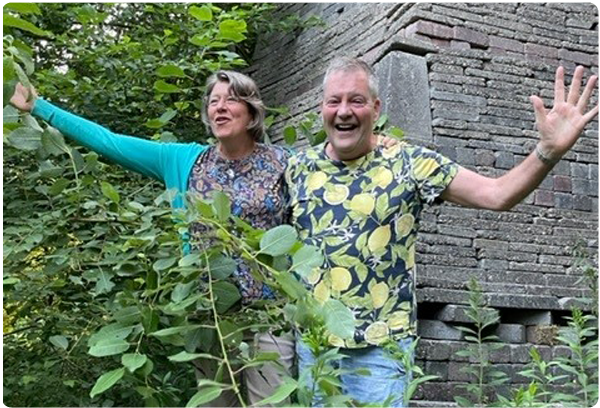
It was wonderful to have an opportunity to hear from René and Harriet again. I am always amazed by the deep sense of presence they both bring to their hostings, and how this always deepens my awareness of that moment and as a result, my connection with my Felt Sense. I am writing this seven weeks later, no notes, so I will stick to my abiding memories and Felt Sense of the session, which are strong still!
René and Harriet both showed videos of them working with children, and it was clear that both young people had been on a journey and come a long way in their ability to connect with Harriet/ René, but more importantly, themselves and their Felt Senses.
As I watched René’s videos, initially it seemed like nothing was really happening, and I wondered why René had chosen that particular snippet of their interactions. I felt I was missing the point - until I had my first ‘A-HA’ moment.
It was the subtlety of fully entering the child’s world and how it was for them. By fully embracing the child’s need to run/ dance/ move and joining in, while having no idea why or what was going on, the child felt deeply heard and acknowledged. It was both a process and a trust that had been building over time - René himself said he had no idea what was happening in the moment, but he was trusting in the child’s innate connection with their felt sense. It unfolded that this was a child who had been quite repressed and this was a ‘coming alive’ they were expressing and sharing, for which René was holding space and entering into - a landmark shift in this child’s way of relating!
René acknowledged his own felt sense of confusion and uncertainty with what was happening, then turned his attention to being present and listening/ reflecting for the child. He calls this ‘Listening in 3 Directions’ - which I understand as paying attention to his felt sense, the other has their felt sense, and he is also resonating with their felt sense. The level of holding and safety this brought was clearly felt by the child in their trust and freedom of expression.
I was struck by a couple of statements in particular which René made
- Having an unconditionally empathic attitude,
- How children can move in and out of felt sensing much more easily/ fluidly/ quickly than adults, and that we need to be aware of this so we do not limit this with adult expectations.
- He talked about how we can encourage felt sense connection through our language - how we reflect their words & what we draw attention to (like noticing and drawing attention to a thick line/ a dominant colour, but not putting meaning on it - opening it to the child to expand), and never asking ‘Why?’
- He stressed the importance of non-verbal communication - noticing and reflecting actions/ movements/ gestures/ tone of voice/ distance… Through verbal and non-verbal communication, our reflecting can make the Felt Sense explicit and deepen the child’s Felt Sense connection.
These themes were further deepened in Harriet’s video. Probably the thing that resonated most for me, was listening to Harriet talk about her earlier work with this child. She explained how he had created a lot of art with her and at the end of each session, he would ball it all up and throw that day’s work in the bin. Everything in me screamed ‘Nooooo!’ and I was amazed by her level of acceptance - ‘Ah, and something in you wants to put that in the bin’. I am still processing my reaction, and it has left an unsettling something in me - making me question so much of my work as a teacher - the implicit judgement in preventing the binning of work, the assumptions that there was anger/ dissatisfaction/ shame leading to him binning things - I realise these are all my projections and my assumptions of a need to protect him from himself! And there is more…
When we watched the video, I was struck by how this boy had reached a point of wanting to show and share his work with others - through the power of having that shared creative experience with Harriet through which he learned to negotiate/ discuss/ come to common agreements by connecting with their felt senses on the right next moves. (Again I am aware of my judgment of this as ‘good’!) And I could see how he transferred that holding of space and these learnings, to wanting to bring others into his experience. But it was only possible because he was allowed to fully express himself in that initial ‘binning’ process, and through Harriet’s acceptance of that was how it was for him at that time.
I came away from this workshop amazed anew by the subtlety and depth of the focusing process, particularly when used with children. I am left with much to ponder, which is still percolating 7 weeks later and challenging me to be a more accepting, more present teacher, but also to see the growth that can come from being less controlling and more trusting of the process. Thank you René and Harriet - a wonderfully rich experience as always!
I know that many people who have explored Focusing can sense that it has a spiritual dimension implicit in the experience. When I use the word spiritual here, I am not referring to any belief system. Rather, I am pointing towards an experience that ties us into a larger process or mystery. A process that includes us but somehow connects us into “more”.
Fr. Ed McMahon and Fr. Peter Campbell, both Jesuit priests, completed PhD research exploring the pathologies of control implicit in all major world religions. They were interested in finding ways to facilitate a greater sense of self-participation in the faith journey.
They discovered many interesting possibilities in the works of Teilhard de Chardin, Abraham Maslow, Carl Rogers, and Karl Rahner just to mention a few.
They knew that when they read Eugene Gendlin’s seminal Focusing Book that a large piece of the jigsaw had fallen into place. They were fascinated by his description of the body as it is sensed from the inside. “Your physically felt body is, in fact, part of a gigantic system of here and other places, now and other times, you and other people—in fact, the whole universe. This sense of being bodily alive in a vast system is the body as it is felt from inside.” Eugene T. Gendlin, Focusing, 1978.
They were so intrigued by the process described in this book that they travelled from California to visit Eugene Gendlin in his new apartment in New York. Sitting on orange boxes in this as yet unfurnished apartment, they asked “where does the felt shift come from, is it contained in the felt sense?”. Gene’s response was “no, it is what you guys call Grace”.
This directly led to the founding of BioSpiritual Institute (as it is known today). And to the publication of “BioSpirituality, Focusing as a way to Grow” and “Rediscovering the Lost Body-Connection within Christian Spirituality”. Ed and Pete travelled the world teaching this process to thousands of people.
BioSpirituality is subtly different to other forms of Focusing, but these differences always preserve the essence of the Focusing process. Ed and Pete and their colleague Sr Jeanne Fallon realised that (in the context of spirituality) they could simplify Gene’s 6 steps into what became the BioSpiritual Flow, of noticing (the body from inside) and nurturing (what comes).
They understood that the Focusing Attitude needed to be more than just a conceptual intention. It needed to be something that was physically experienced in the body. The experiences of love and affection in our lived experience is what they called our Affection Teachers, teaching us how to be physically lovingly present to our important feelings and emotions.
Ed and Pete also discovered that Process Skipping could be an obstacle to being lovingly present to our bodily experiencing. This process, that operates on a subconscious level offers a doorway into living more fully into what is “real” in our experiencing.
Fr. Ed passed away in 2013, and with Fr Peter in failing health, the board of the Institute mobilised all of their resources to ensure that their lifetime’s work would be preserved.
In 2023, the BioSpiritual Institute has 5 designated educational centres and through these centres and on our online offerings, we have facilitated the training of over 1,000 participants this year.
We continue to grow, and we are eternally grateful to the International Focusing Institute for their support.
If you are interested in learning more about BioSpirituality please have a look at the website www.biospiritual.org or contact me at
Thank you for taking the time to read this.
John Keane
International Director
BioSpiritual Institute.